Showing posts with label brain exercise. Show all posts

Thursday, 28 May 2020

IQ and your Brain


IQ and your Brain


Like an unbreakable bond, IQ and your brain
are inseparable. For some, learning seems innate; mathematics seems
effortless. But for many of us, it is a different story. So, can we
improve our own IQ.


The debate has been raging for centuries; is intelligence innate or
can it be improved by interventions? Are we born with the necessary
intelligence for learning and success or is our environment responsible
for shaping us? Can we, in fact, shape our own cognitive ability?


Many people believe that our intelligence levels are limited by
biology on IQ and memory. While other psychologists have shown that IQ
can be raised (see Cassidy, Roche & Hayes, 2011) leading to
permanent increases in IQ (Roche, Cassidy &Stewart, 2013). Note: Cassidy and Roche are co-founders of RaiseYourIQ.


There can be different meanings to what we term intelligence. There
is our “biological intelligence” (also known as neural efficiency. Then
we have “psychometric intelligence” which is our measured IQ score (a
method of estimating our biological intelligence).


The question is can we increase our biological intelligence? The
research carried out in the past decade using various intervention tools
(aka, brain training) have proven that it is possible for us to boost
our neural efficiency and mental horsepower. Our cognitive ability can
be made to work more efficiently. and in a more synchronized manner.


More research from Jaeggi (2008) showed that intellectual functioning
could be improved. So, do these studies show us that our IQ score is no
longer a number that limits our ability to grow. Interestingly, some of
the greatest scientific minds of recent times possessed IQs below what
we would call highly intelligent. People such as Richard Feynman, James
Watson and William Shockley all had average IQs.


Another point worth making is that to measure improvement in IQ also
requires us to consider how our intelligence is being measured in the
first place. We should not confuse ability with knowledge. Any of us can
study and improve our vocabulary. But does that make us smarter? To
really measure intelligence, we need to measure the abilities that
underlie the acquisition of knowledge, not the knowledge we current
process.


“High, but not the highest intelligence, combined with the
greatest degree of persistence, will achieve greater eminence than the
highest degree of intelligence with somewhat less persistence”


Other psychologists have discovered that there is a strong link
between what they term “relational skills” and IQ scores (O’Hora, Pelaez
& Barnes-Holmes; 2005, O’Toole & Barnes-Holmes;2009, Cassidy,
Roche & Hayes; 2011, Roche, Cassidy & Stewart; 2013). They
showed that these relational skills can be taught which in turn triggers
an increase in IQ scores.


What does relational skills have to do with IQ?

The psychologist mentioned above state that “relational skills are
the understanding of mathematical relationships between concepts or
objects such as things are the same as other things, more or less than
other things, opposite to other things etc” The proved that having a
strong handle on the relationships between and among other things has
been shown to enhance thinking and problem solving skills. Relational
skills are now referred to as the building blocks of intelligence by
psychologists in the field of Relational Frame Theory.


Research from 2011 has shown that using Relational Frame Theory as an intervention can significantly improve IQ scores in children. A more recent study using this intervention also found improvements in IQ, verbal reasoning, and numeric reasoning.


Activities that involve relational training include:


  • language learning books (“this is a…” and “that is a…”)
  • object comparisons (full cup versus empty cup)
  • amount comparisons (penny versus dime)
“While we may continue to use the words smart and stupid, the
monopoly of those who believe in a single general intelligence has come
to an end


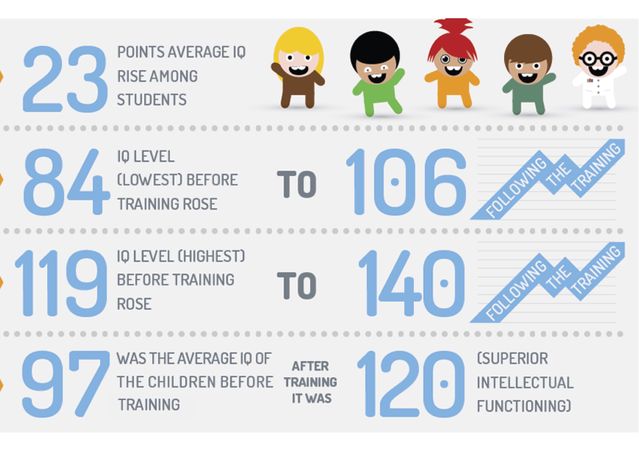
A study aimed to replicate and extend the pilot findings of Cassidy
et al. (2011) which found that teaching children to derive various
relations among stimuli leads to increases in the full scale IQ scores
of both typically developing children and those with educational and
learning difficulties. In the first experiment , fifteen 11–12 year old
children were exposed over several months to an intensive training
intervention to improve their understanding of the relations Same,
Opposite and More and Less. Significant increases in full scale IQ of
around one standard deviation were recorded for each child. In the
second experiment, the same intervention was delivered to thirty
15–17 year old children. Significant increases in verbal and Numerical
Reasoning were recorded for almost every child. These findings
corroborate the idea that relational skills may underlie many forms of
general cognitive ability.


IQ and our Mindset

Scientists now believe that our mindset matters not just on an
emotional level, but also on a physiological level. The fact that we
believe we can improve our learning capability will enhance our
performance in any learning environment. Persisting with tasks even when
they are difficult will help us complete them. We have evidence of this
in business and sport. The ability of those who are less gifted
technically, working harder to achieve higher results. As one
psychologist put it “when the chips are down, the person or kid who
works harder will help themselves to deliver the results.”


This mindset is about getting outside of our comfort zones in a
focused way, having clear goals, with a plan for reaching those goals,
and a way to monitor our progress. Research shows that we can increase
our brain’s functioning by pushing ourselves to learn things that are
outside of our current skill set.  Learn to play an instrument, a new
language, or a new skill. This has the effect of exercising our brain in
a new way which expands our brain’s neural networks.


Also, as some of our abilities such as fluid reasoning, crystallized
intelligence or verbal abilities are more stable over time, others are
less stable as in short-term memory and cognitive processing speed. So,
working our brain or doing brain exercises can increase brain
functioning.


IQ and our Brain

More and more evidence based, and scientifically validated research
seems to point to the fact that it is possible for us to raise our
intelligence levels through brain training activities.Memory training,
executive control, and reasoning can help to boost our intelligence
levels. The best way to train these areas of our brain is to engage in
thoughtful activities and games, learn new skills, and keep our brains
active.


IQ and your Brain


Monday, 11 May 2020

Brain exercise for wellness

Brain exercise for wellness: Brain Exercise for Wellness


Brain exercise for wellness and mindfulness is important at any time but especially in times of stress or uncertainty. We have evolved to move, for both our bodies and our brain. Both have become fine-tuned to overcome challenges and crisis across the centuries. Research is showing the toll this relatively new sedentary lifestyle is taking on our bodies. In the U.S. the expected life span of younger generations will be shorter and unhealthier than the lives of their parents. Doctors tell us we should be going to the gym, exercise daily, and eat the right kind of food.

While this advice is helpful, many of us forget about another important part of ourselves: our brain. If all accept that psychical exercise is good for our bodies then you should also accept what medical research has long suspected, that the same holds true for our brains. Numerous university and medical research projects have gone into examining the effect of brain training and brain exercise to improve attention, memory, and IQ. Published studies now show very consistent findings that the brain works better after exercise.

The past decade has provided psychologists and scientists with the tools to understand the mechanisms at play to improve our brain via exercise. We know that Relational Frame Training alongside other brain exercise routines lead to changes in how the brain operates. The effect has bolstered the ability of kids to learn, given adults increases relating to cognitive tasks, and even to reduce the cognitive decline associate with aging.
So, let’s talk about the impact of brain exercise for wellness has on your head and your heart.

Brain Exercise Gives Our Brain a Boost

During brain exercise it becomes much more active than at any other time. All of us have two types of brain waves caused by synchronized pules, these are lower frequency and higher frequency waves. The lower frequency waves are to do with tasks such as washing, sleeping, shopping and other routine tasks. While higher frequency waves (known as beta waves) occur when we are mentally active and are associated with our attention, working memory and mental processing capabilities.
Researchers have found that brain exercise has an impact on both the amplitude and frequency of brain waves. This means we become more alert and engaged. Similar to our overall health, if we don’t exercise our bodies, it will deteriorate over time, same goes for our brains if we don’t exercise it.

Build Up Your Neurotransmitters

Very similar to the way that our muscles require a lot more energy during exercise, the brain consumes glucose and other carbohydrates when it and our bodies are active.
Scientists have discovered that our brains will use some of this energy to build more neurotransmitters. These are the chemicals that relay messages around our nervous system. The conclusion is that brain exercise and physical activity has the effect of restocking our brains with essential neurotransmitters to operate optimally.
In fact, this may be why exercise in general has been shown to alleviate depression.
A Younger Brain
We know from published studies which suggest that exercise kickstarts the production of growth factors which nourish new neurons while helping existing cells survive. One such study found that mentally and psychically active people tend to have healthier blood vessels plus a brain that appears to be younger.
While these changes in our brains can take at a few weeks to develop, they do lead to long lasting improvements in the regions of our brains associated with cognitive tasks such as working memory.
Research carried out in the 1990’s showed that our brain will reach its peak performance between the ages of 16 and 25. After that, our cognitive functioning or our ability to mentally process and carry out tasks starts to decline naturally. So, our ability to change, process certain tasks, and introduce new processes will become harder.
We should understand the importance of this since brain exercise programs have been are designed to keep our brain functional. A few simple examples of this is being able to do our daily tasks, remembering information, retaining memories, and ability to focus. This may not seem a big issue now, however it will become more relevant as we age when the threat of dementia, amnesia, or Alzheimer’s appear, issues that could be reduced through regular brain exercise.
Even more research into aging adults and brain exercise have shown an increase in Gray matter volume in regions of the brain associated with general intelligence and executive functions. This includes everything from our attention skills to planning to our problem-solving capabilities.
Increased Focus and Concentration Skills
Regular exercise changes the number of neurons in our brains and how they communicate. People who exercise regularly show increased connectivity between parts of the brain involved in memory, attention, decision-making, multitasking, and processing information. At the same time, people who focus on skills and repeated attention to detail tasks have lower connections with a region of our brains usual associated to mind wandering. This indicates that fit and healthy people may have increased focus or concentration skills.

Do Brain Exercise Techniques Work?

Doctor Bryan Roche and Doctor Sarah Cassidy, the co-founders of RaiseYourIQ have published several scientific papers on our Relational Frame Training can increase your IQ and other gains relating to improving cognition and brain fitness. Dr. Roche has developed an online intervention, based on Relational Frame Theory, that is the only intervention currently known by psychologists to increase IQ by clinically significant degrees (around 15 points) for many or most users. This method is known as SMART (Strengthening Mental Abilities with Relational Training).
Dr. Roche also conducts research into fear and avoidance as part of wider interest in anxiety, and has developed a new implicit test, built from first learning principles, called the FAST (Function Acquisition Speed Test), also available online as a test and in modified form as a therapeutic intervention to enhance psychological flexibility in the context of troubling emotional issues.

Final Thought on Brain Exercise

There are numerous reasons to consider a brain exercise regime just the same as physical exercise to maintain our health. Brain training exercise do not take very long and can easily become part and parcel of our daily lives. Furthermore, we now know that a brain exercise program can improve our focus, learning, working memory, IQ and most importantly, our ability to enjoy undertaking daily activity with ease.