Showing posts with label brain. Show all posts

Thursday, 28 May 2020

IQ and your Brain


IQ and your Brain


Like an unbreakable bond, IQ and your brain
are inseparable. For some, learning seems innate; mathematics seems
effortless. But for many of us, it is a different story. So, can we
improve our own IQ.


The debate has been raging for centuries; is intelligence innate or
can it be improved by interventions? Are we born with the necessary
intelligence for learning and success or is our environment responsible
for shaping us? Can we, in fact, shape our own cognitive ability?


Many people believe that our intelligence levels are limited by
biology on IQ and memory. While other psychologists have shown that IQ
can be raised (see Cassidy, Roche & Hayes, 2011) leading to
permanent increases in IQ (Roche, Cassidy &Stewart, 2013). Note: Cassidy and Roche are co-founders of RaiseYourIQ.


There can be different meanings to what we term intelligence. There
is our “biological intelligence” (also known as neural efficiency. Then
we have “psychometric intelligence” which is our measured IQ score (a
method of estimating our biological intelligence).


The question is can we increase our biological intelligence? The
research carried out in the past decade using various intervention tools
(aka, brain training) have proven that it is possible for us to boost
our neural efficiency and mental horsepower. Our cognitive ability can
be made to work more efficiently. and in a more synchronized manner.


More research from Jaeggi (2008) showed that intellectual functioning
could be improved. So, do these studies show us that our IQ score is no
longer a number that limits our ability to grow. Interestingly, some of
the greatest scientific minds of recent times possessed IQs below what
we would call highly intelligent. People such as Richard Feynman, James
Watson and William Shockley all had average IQs.


Another point worth making is that to measure improvement in IQ also
requires us to consider how our intelligence is being measured in the
first place. We should not confuse ability with knowledge. Any of us can
study and improve our vocabulary. But does that make us smarter? To
really measure intelligence, we need to measure the abilities that
underlie the acquisition of knowledge, not the knowledge we current
process.


“High, but not the highest intelligence, combined with the
greatest degree of persistence, will achieve greater eminence than the
highest degree of intelligence with somewhat less persistence”


Other psychologists have discovered that there is a strong link
between what they term “relational skills” and IQ scores (O’Hora, Pelaez
& Barnes-Holmes; 2005, O’Toole & Barnes-Holmes;2009, Cassidy,
Roche & Hayes; 2011, Roche, Cassidy & Stewart; 2013). They
showed that these relational skills can be taught which in turn triggers
an increase in IQ scores.


What does relational skills have to do with IQ?

The psychologist mentioned above state that “relational skills are
the understanding of mathematical relationships between concepts or
objects such as things are the same as other things, more or less than
other things, opposite to other things etc” The proved that having a
strong handle on the relationships between and among other things has
been shown to enhance thinking and problem solving skills. Relational
skills are now referred to as the building blocks of intelligence by
psychologists in the field of Relational Frame Theory.


Research from 2011 has shown that using Relational Frame Theory as an intervention can significantly improve IQ scores in children. A more recent study using this intervention also found improvements in IQ, verbal reasoning, and numeric reasoning.


Activities that involve relational training include:


  • language learning books (“this is a…” and “that is a…”)
  • object comparisons (full cup versus empty cup)
  • amount comparisons (penny versus dime)
“While we may continue to use the words smart and stupid, the
monopoly of those who believe in a single general intelligence has come
to an end


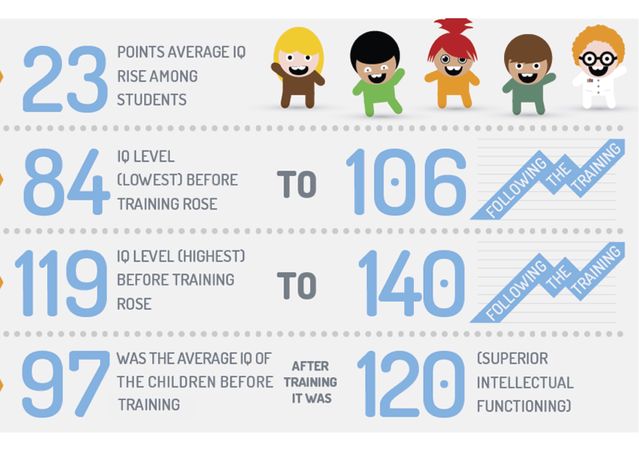
A study aimed to replicate and extend the pilot findings of Cassidy
et al. (2011) which found that teaching children to derive various
relations among stimuli leads to increases in the full scale IQ scores
of both typically developing children and those with educational and
learning difficulties. In the first experiment , fifteen 11–12 year old
children were exposed over several months to an intensive training
intervention to improve their understanding of the relations Same,
Opposite and More and Less. Significant increases in full scale IQ of
around one standard deviation were recorded for each child. In the
second experiment, the same intervention was delivered to thirty
15–17 year old children. Significant increases in verbal and Numerical
Reasoning were recorded for almost every child. These findings
corroborate the idea that relational skills may underlie many forms of
general cognitive ability.


IQ and our Mindset

Scientists now believe that our mindset matters not just on an
emotional level, but also on a physiological level. The fact that we
believe we can improve our learning capability will enhance our
performance in any learning environment. Persisting with tasks even when
they are difficult will help us complete them. We have evidence of this
in business and sport. The ability of those who are less gifted
technically, working harder to achieve higher results. As one
psychologist put it “when the chips are down, the person or kid who
works harder will help themselves to deliver the results.”


This mindset is about getting outside of our comfort zones in a
focused way, having clear goals, with a plan for reaching those goals,
and a way to monitor our progress. Research shows that we can increase
our brain’s functioning by pushing ourselves to learn things that are
outside of our current skill set.  Learn to play an instrument, a new
language, or a new skill. This has the effect of exercising our brain in
a new way which expands our brain’s neural networks.


Also, as some of our abilities such as fluid reasoning, crystallized
intelligence or verbal abilities are more stable over time, others are
less stable as in short-term memory and cognitive processing speed. So,
working our brain or doing brain exercises can increase brain
functioning.


IQ and our Brain

More and more evidence based, and scientifically validated research
seems to point to the fact that it is possible for us to raise our
intelligence levels through brain training activities.Memory training,
executive control, and reasoning can help to boost our intelligence
levels. The best way to train these areas of our brain is to engage in
thoughtful activities and games, learn new skills, and keep our brains
active.


IQ and your Brain


Brain Speed Games to Improve Skills


SMART Brain Speed Training

The SMART Brain Speed game will improve your information processing and visualization skills. At RaiseYourIQ we know that fluency is a crucial part of your intellectual activity. How quickly your brain can process the events around you determine how effectively you can react to and remember those events. 

At RaiseYourIQ we believe the key to improving processing speed lies in making stronger connections in your brain, which allow your brain signals to travel at higher speeds. Though most of this type of hard wiring of the brain occurs during childhood, you can still take action to sustain and even potentially improve your brain’s processing speed. 

Our game will help you increase your relational skill fluency by choosing any training stage that you have mastered within SMART, but which still challenges you. You then select a lower response time limit within the game to enhance your fluency.

When we talk about the processing speed of the brain, we are referring to the rate at which anyone can take in a new piece of information, reach an understanding about it, and then formulate a response to it. Based on this definition of fluency, we believe the key to improving your brain processing speed lies in making stronger connections in the brain, which allows your brain signals to travel at higher speeds. 

The science behind SMART Brain Speed is that it works on the long-term transfer of processing-speed training skills to real-world educational, professional, social, communication, and life skills.
 

Brain Speed Games to Improve Skills

Intellectual Development Help

Intellectual and cognitive development is not limited to children as adults brain functions also continue to grow throughout life stages. Intellectual development is all about our ability to process information, learn, think and understand various strands that surround our living world. Brain training works to improve our cognitive abilities and develop skills in logical reasoning, memory, maths, science, reading, writing and verbal comprehension.

RaiseYourIQ has developed the "SMART Brain Training" platform to help people improve IQ, expand their logic and reasoning abilities while matching thinking and planning abilities with actions.

Cognitive training exercises are a series of brain games, tasks and puzzles to be completed by the adult or kid user. Cognitive training (brain training by another name) works to increase fluid intelligence which can be defined as the ability to solve “on the spot” problems that cannot be performed by relying on previously learned habits. Research has shown large improvement in the brains reasoning skills when people engaged in working memory training while people who consume trivia knowledge via games show no improvement in reasoning skills.

Clinical data shows people who complete cognitive training will attain

(a) high working memory,
(b) high cognition skills while
(c) addressing any cognitive deficits.

Monday, 9 December 2019

tips on how to improve your memory

tips on how to improve your memory: Improve Your Memory


How to improve your memory for both short- and long-term recall is not as difficult as it may appear. Yes, there are techniques to improve memory however it does take practice to maintain a higher level of memory recall. Clinical research has shown that memory is an essential component of cognitive functioning and that this too can be improved (Jaeggi et al., 2008). This research also show that our IQ score is no longer a number that limits us. Read on to get tips on how to improve your memory and raise your IQ.

Tips on How to Improve Your Memory 1. Practice and rehearse Start by really understanding the topic or piece of information you wish to remember, then once you have the basic understanding in place you will need to keep rehearsing the information to ensures it sticks. That old saying of practice makes perfect is very relevant when you are trying to remember new things. If you want to make information come to mind automatically, you need to rehearse it regularly. Then you will be able to recall it quickly when you need to, whether that be for school, business or at social events.

2. Pay attention and engage with information Psychologists Craik and Lockhart found that the more attention we pay to the meaning of what we see, hear and learn, then the better we will remember it. They proved that improving our memory is a function of how effortful and meaningful our initial encoding of the information was. The outcome is if we process information on a deeper level, we will be better able to recall that information. Psychologists and teachers tell us that understanding something aids our memory and it is harder to remember things if we merely rote learning without fully comprehending the information.

3. Visualize and use imagery We live in a visual world which means there are many ways that we can use the power of visual imagery as a memory aid. For example, try using a mind map, where we imagine a map of the information or a tree with the branches that stem out each holding an important and relevant fact or nugget of information. Another example is to imagine a cloakroom with each of the pegs holding a piece of information. Whatever method you prefer, the key point is that when we visualize the information as we study or learn it, we can recall it later much easier.

4. Try Drawing Drawing is a great way to help anyone with remembering new information, but especially for older adults. This has been backed up from research conducted at the University of Waterloo in Canada. They found that drawing out words and drawing the physical attributes of a word enhanced the memory of older adults with possible benefits for people suffering from dementia. Drawing is a memory encoding technique that works cross generational and kids find it fun and educational.

5. Start using acronyms Research has shown that our brains are better at retrieving things when we associate meaning to them. When we were in school, a teacher or parent likely taught us to use acronyms and my guess is that most of us still remember some version of these. Remember this one? to memorize the directions on the compass, we use the acronym NEWS (North, East, West, and South). Or this one? “My Very Educated Mother Just Served Us Nine Pizzas” (Mercury Venus Earth Mars Jupiter Saturn Uranus Neptune Pluto). Not only are acronyms fun and they really work. You can also use a similar technique if you are trying to remember names at a party or gathering (e.g., Black orange boots for Bob or Purple attire things for Pat. Go ahead and make up your own acronyms for anything you want to remember. The trick is to list the thing you want to memorize and arrange it in an order such that the first letter of each word spells a real word.

6. Pay attention to the beginnings and endings Research on how to improve your memory points to the fact that that we remember more at the beginning and end of learning sessions or lessons. Now none is suggesting you zone out in the middle of a lesson, lecture or training session. This is about being aware of our optimal memory times. So, listen up and pay closer attention to the introductions and conclusions when being presented with information. Always ask a teacher or the presenter to summarize the main points of the lesson or lecture again at the end.

7. Try brain training Some (not all) Brain Training to Raise IQ programs can help improve your memory and raise your IQ. It may surprise you that the brain is a muscle much like other muscles in your body. Your brain needs constant use and exercise to stay healthy. Think of brain training as a mental workout which helps challenge your mind so it can grow and expand. Research carried out by our own Dr. Bryan Roche found that people who engaged with 20- 30 minutes of brain training activities (using relation frame theory) for 5 days a week had improvements in learning, mathematical and verbal skills, educational aptitude, working memory, Performance IQ, verbal IQ, perceptual reasoning skills, visual processing skills, working memory and general intelligence. This was for users of all ages and intelligence levels.

8. Practice Meditation Researchers from The Department of Motor Sciences and Wellness, University of Naples “Parthenope”, Naples, Italy note that many studies show meditation improves brain function, reduces markers of brain degeneration, and improves both working memory and long-term memory. They showed that routine meditative practice is associated with a long-lasting change in the topology of definite brain areas, suggesting that meditation might be able to induce brain plasticity.

9. Read It Out Aloud You may remember from your school days, when your teacher asked you to stand up and read out aloud a story or poem. Well, a team at the University of Waterloo found that you’re more likely to remember written information if you read it out aloud. The consensus is that reading combined with hearing yourself reading can have a positive effect to improve your memory. Other studies also confirm that learning and memory benefit from active involvement. When a person adds an active element to a word (reading it out aloud), that word becomes more distinct in long-term memory, and so more memorable.

Improve Your Memory Summary These are just 9 ways to improve your memory, we are sure there are many more techniques for improving memory, all of which would be beneficial for a person's brain health. Why not start today, whether you are a student, professional or a retiree. Because even adding one or two memory improvement activities to your daily routine can help keep your brain healthy and strong. To improve your memory not only protects the brain from memory loss but it will also boost learning and information recall. If you would like to dig deeper into The Science Behind Brain Training the science of brain training, then read here – Smart Brain Training

Friday, 5 December 2014

Increase Intelligence

Anyone can increase intelligence as the brains memory is an essential part of the brains intellectual functioning and that this can be improved (see Jaeggi et al., 2008). These studies and others into intelligence show that IQ scores can be improved and that an IQ test is merely a good starting point for kids or adults to commence a journey towards increasing intellectual skills for meaningful gains in all walks of life. So what does it take to increase intelligence and raise IQ? Well advice from Doctor Sarah Cassidy, an educational psychologist and a co-founder at RaiseYourIQ includes


Psychologists have discovered that there is a strong correlation between a person’s relational skills and IQ scores (O’Hora, Pelaez & Barnes-Holmes; 2005, O’Toole & Barnes-Holmes;2009, Cassidy, Roche & Hayes; 2011, Roche, Cassidy & Stewart; 2013). Crucially we now know that relational skills can be taught to any person.


So improving your relational skills will in turn increase your IQ score. So what are Relational skills?, they are the understanding of a handful of mathematical relationships between concepts or objects such as things are the same as other things, more or less than other things, opposite to other things, and so on.


They also include relationships like before and after or that one thing is contained by another. Moreover, having a strong handle on the relationships between and among other things has been shown to enhance thinking and problem solving skills. In fact, these relational skills are now being called the building blocks of intelligence by psychologists in the field of Relational Frame Theory.

Read the full article here Increase Intelligence


Thursday, 2 October 2014

Is it really possible to increase intelligence?

We were once told that intelligence or IQ was fixed for life. However,years of research by doctors and psychologists has lead to thediscovery of the importance of relational skills to intelligence and it
took several more years to by scientists to figure out how best to teach these skills. Today we know that IQ can in fact be increased by quite a degree. There have also been considerable advances in neuroscience in recent years, that have led psychologists to conclude that the brain itself can be made “fitter” with training and can respond and adapt to improved learning opportunities. Even leading authorities, such as Professor Robert Sternberg, now agree that IQ can be raised.

People who have completed the SMART brain training course have seen an average 20-50 point increase or improvement in intelligence or IQ (in both formal IQ tests and IQ assessments). The whole principal andscience behind RaiseYourIQ is teaching people how to learn easier. So mathematics, reasoning,problem solving memory recall and verbal comprehension become easier to understand hence working the brain fitter. The proof of this process lies in taking a pre and post IQ
assessment test which is free at RaiseYourIQ. Many of our users take SMART brain training to help in education, exams, work tests and IQ tests like MENSA. increase intelligence

Friday, 5 September 2014

Brain training for Children

Teachers, Guardians and Parents should consider using brain training for children and students to help improve their IQ levels and so assist them in their educational pursuits. The idea that a childs or persons Intelligence Quotient (IQ) is fixed for life is a myth and for far to long as been used as an excuse for poor teaching and learning methods.


 Brain training for Children

If a childs brain needs a power up, then the RaiseYourIQ intellectual skills intervention called "SMART brain training" (Strengthening Mental Abilities with Relational Training). We do not teach children and students anything that they can use in their examinations (e.g., how to multiply, the capital of Canada). Instead a RaiseYourIQ course will teach the foundational reasoning skills crucial to vocabulary acquisition and mathematical reasoning. In effect, we are giving kids, students and adults the tools to learn more effectively. Moreover our training re-mediates deficits in these skills bases that cannot be taught at school efficiently without extensive one-to-one assistance, plus SMART can even help children to catch up to and even surpass the population average in intellectual ability. The SMART brain training course can act as a springboard from which future learning occurs across all age groups.


Monday, 1 September 2014

Brain Training Exercises

The brain training exercises on RaiseYourIQ are designed to improve the ability of the brain to learn faster and easier. Brain training exercises are similar to revision sessions in school or on a business presentation. As each brain training module is completed, there is revision time to repeat and re-learn information, facts, and formulas. The main difference in progressing through brain training exercises is that the focus is on strengthening the weak areas of the brain to make these fitter so to make learning easier.
So brain training exercises really challenge the brain by gradually building up the complexity of the exercises over a period of time.


Here is an example of a brain training exercise from RaiseYourIQ. Try it for yourself.

If an object B is larger than another object C,and an object A is larger than B, and an object D is smaller than object C, is D less than or more than A?


To learn more and get 15 free brain training sessions plus a free IQ assessment click here.
Brain Training Free Trial


Thursday, 28 August 2014

Identifying the Basic Building Blocks of Intelligence | Psychology Today

This Psychology Today article on the Building Blocks of Intelligence was written by Doctor Bryan Roche in his IQ Boot Camp expert blog, Bryan is a co-founder of RaiseYourIQ.com. In this article he poses the question "Will honing your relational framing skills make you smarter?"

The full article can be read on Psychology Today at the below link


Identifying the Basic Building Blocks of Intelligence | Psychology Today