Showing posts with label brain fitness. Show all posts

Monday, 8 June 2020

You Can Improve IQ

 You have probably heard that you cannot improve IQ. But that is not strictly true.

Can we improve IQ or is IQ fixed for life? Well, you may have read in various places that your IQ is fixed for life. That is somewhat true - but for surprising reasons is also misleading. In truth the apparent stability of your intelligence is somewhat of a trick conjured up by intelligence test developers, psychologists and statisticians who have already started their work from the position that you cannot improve IQ meaning intelligence is fixed for life.


This idea is based on little more than the intuition of Sir Francis Galton, and the pondering of some early IQ researchers such as Catell, Spearman and Sir Cyril Burt. Some of these researchers had political motivations for this position, and indeed Sir Cyril Burt was posthumously disciplined for by the British Psychological Society for faking his IQ research data to fit with the idea that IQ is fixed for life and is determined biologically.


No psychological research has ever FOUND that intelligence is fixed
for life.  Instead, tests for general and specific intellectual ability
are developed in such a way that your score from one test take to
another (say a year apart) will not change much.  The simplest way in
which this is achieved, is by masking the gain in your improvement over
time by NOT calculating your real raw score on the test, but instead
calculating your score in terms of how it compares relatively to people
of your age.


Because everyone of your age is improving intellectually at the same
rate this way of scoring the IQ test creates the false impression that
you are not getting any smarter.  Indeed, the whole population is
getting smarter (an effect known as the Flynn effect), but tests are
regularly revised to make sure that this is disguised.  The tests are
designed in advance so that someone in the bottom 20 percent of the
population, for example, will continue to score well below the average
score.  As the population becomes smarter, the gap closes between the
raw score of someone on the 20th percentile and the average score of someone on the 50th percentile (always defined as a score of 100).


The newer tests open the gap again to keep the low scorers scores
down and away from the average score.  This is intended to disguise the
fact that the lowest scorers in the population are in fact doing much
better than people just one generation ago.  More illusion and confusion
for the general public!


You Can Improve IQ and The Data Proves it!

Aside from errors in the logical argument that IQ must be fixed for
life, based on the finding that your IQ scores do not change across time
much (when the test is rigged to guarantee that!), it is simply NOT
true that people do not develop and improve intellectually. Admittedly,
the evidence is weak that you can achieve large IQ gains from simply
playing a brain training app.  But the evidence is not weak, that you
can show improvements in IQ from targeted educational interventions,
such as those developed within the field known as Applied Behavior
Analysis. Practitioners in that field have, for many decades, been
producing exceptionally large IQ gains in children with learning
difficulties.


Across many scientific papers that I (Dr. Bryan Roche) and others
have published over the past decade, it has been shown repeatedly that
scores on a wide variety of standardized measures of intelligence and
cognitive abilities, can be raised significantly using a Relational
Frame Theory-based intervention known as SMART (Strengthening Mental
Abilities with Relational Training) that does not involve training of
skills directly relevant to IQ tests.


free brain training


The SMART method is closely related to the types of techniques used
in Applied Behavior Analysis and was developed across several peer
reviewed scientific papers.  Calling the SMART method “brain training”
may be a bit of an over-simplification.  It is targeted fundamental
intellectual skills training done in a digital format.   We have argued
for many years that this is clear evidence for “far transfer”. That is,
we consistently get very large gains in IQ for most or all users of
SMART training, that we have made available at RaiseYourIQ.com, on every
and all measures employed to asses intelligence (e.g., arithmetic,
vocabulary, reading), despite the fact that our intervention is in no
way “training to the test”. That is, there are no IQ test items in our
training.


Our classic online training uses nonsense words only (no recognisable
or nameable words or shapes of any kind). Our training for younger kids
does use images and real words as a workup to the classic training so
widely cited in the scientific research literature. We train only a
small number of syllogistic-style reasoning tasks that we have
discovered are relevant to almost every aspect of intellectual
functioning.  But we do it across thousands of tasks over many months of
casual training in an online game-like environment.


you can improve IQ:


Despite the admittedly almost unbelievable results obtained for the effects of SMART training at RaiseYourIQ.com,
across several studies from several labs using several different
measures across several different populations, the public is still not
convinced that IQ tests of all kinds measure a flexible skill set rather
than a fixed trait and that you can in fact Raise Your IQ. The data is
out there. The data is published in peer reviewed scientific journals of
all kinds.  The discussions of this data happen at conferences all over
the world – but it takes time for these ideas to replace well-worn
tropes about the fixedness of intelligence.  That old idea is stuck
firmly in the public psyche, even though the evidence for this outdated
position is questionable in terms of theory and incorrect in terms of
empirical data.


WHAT underlies my IQ score then?

What our research program at Maynooth University, Ireland, has
found, is that there is indeed an underlying factor that determines our
IQ score, but it is not something we are born with – it is a skill set
that is in fact quite easy to teach and improve.  That skill set is
known as Arbitrarily Applicable Relational Responding (AARR),
which is a technical way of referring to a very particular type of
logical reasoning that underlies all higher levels of day-to-day
intellectual activity (reading, problem solving, language acquisition). 
Dozens of published studies in the field of Relational Frame Theory
have shown that this skill is easily improved, and others, mostly using
SMART training, have shown that when we do this, large IQ gains follow.


Here is an example of the type of AARR training task that we might
use in SMART training. This example uses what we call nonsense words and
requires the user to solve a logical puzzle of a very particular type.


CUH is opposite to DEJ


ARU is the same as GEY


ARU is opposite to DEJ.


Are CUH and GEY the same?


It is NOT important for the user to know the answer at the outset (the answer is yes!). This is not a test.  It is training. 
What is important is that across thousands of such examples (many
easier than this example) we teach users the correct answers, and so
they learn the very large pattern of possible ways in which such logical
statements lead to logical conclusions involving relationships among
words or things in the world.  We increase the speed and accuracy of
users on such tasks in logical stages, from the lowest level upwards,
using an algorithm that we have worked out across research studies. When
we do this people get smarter. 


It is time to change our view of Intelligence

 SMART training for intelligence improvement


It is said that science is a self-correcting process. The data will
always correct the theory and lead us forward in developing more
effective ways to help people.  Now, old fashioned and outdated
intelligence theory is moving further and further away from the
empirical facts. The political reasons for holding on to those old ideas
is hampering, rather than helping us in developing better interventions
to improve IQ and raise the intellectual ability of the world’s entire
population. It is time to move on and get with the data.  For more
information and research references visit SMART brain training

Friday, 29 May 2020

The SMART brain training games from RaiseYourIQ

The SMART brain training program is a revolutionary cognitive enhancement system
developed by the scientific researchers at RaiseYourIQ. 


SMART is a scientifically developed educational brain training that has been
proven in published scientific research to raise intelligence levels (IQ) (as measured
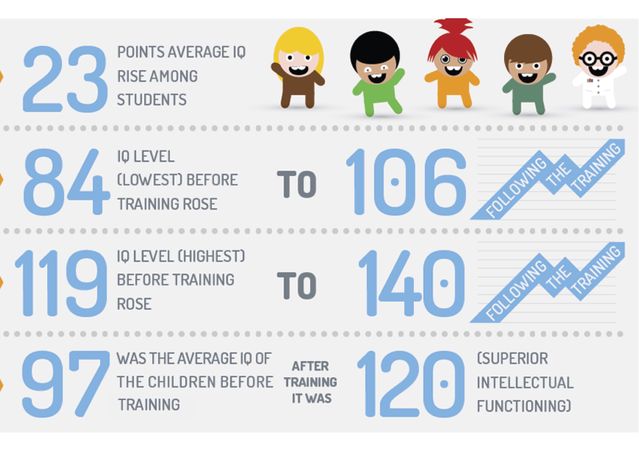
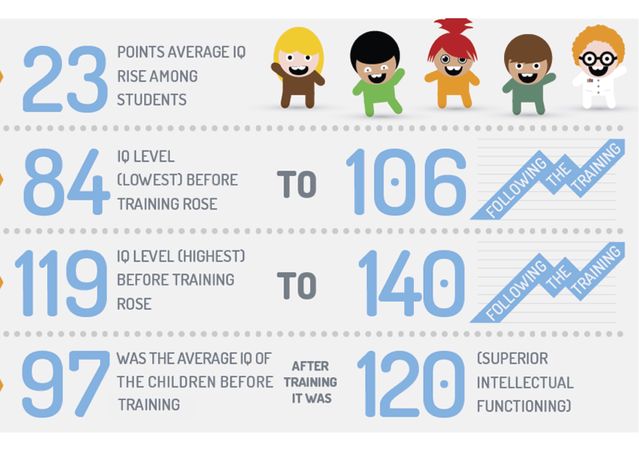
using standardized IQ tests) by 20 - 30 IQ points. That makes SMART brain training a
breakthrough in psychological science.

The founders of RaiseYourIQ, Dr Sarah Cassidy and Dr. Bryan Roche are established
University-based researchers in the behavioral and cognitive sciences and have had their
scientific work on learning and cognition published across a wide range of reputable
scientific journals.

SMART brain training helps kids and adults to become expert in a range of critical
cognitive skills, called Relational Skills. These skills underlie just about everything
we do in school, business, at work and in normal day-to-day decision making and
problem-solving. 

SMART the only system of brain training, that has been proven to enhance general
intelligence and its components, as well as reading ability, numerical ability and
educational aptitude. The SMART brain training program is adaptable to people of all
ages, from kids to adults, helping them to make learning easier, improve memory recall
and exercise their brains to raise IQ.


The SMART brain training games from RaiseYourIQ:

SMART brain training games for children and adults: scientifically proven brain training games based on relational frame theory to improve intelligence, IQ and learning.


A relational skill is a skill involved in understanding
the relationship between things in the world. Understanding the
relationships between a set of cousins, or understanding that a
particular group of plants are all of the same kind (e.g., flowers), or
understanding that a Poodle is a type of dog but a dog is not a type of
poodle, are all examples of basic relational skills. But of course, they
get more complicated than this. The relational skills you need to
understand high level mathematics or to read and speak well, are more
advanced skills. SMART brain training teaches a range of basic but
crucial relational skills and brings your relational skills to expert
levels, so that all intellectual tasks come easier. SMART brain training
makes you a faster and better learner. SMART helps new information make
more sense, and helps you think more clearly. 

The SMART brain training course from RaiseYourIQ is
divided into levels with blocks of questions. The program involves
teaching the user how to answer blocks of logical questions, first with
feedback – and then on their own without any help. There is 30 seconds
to answer each question. During training blocks, we tell you whether
your answer is correct. During test blocks you need to answer all the
questions on your own. Once you pass a test, you move on to the next
level. You progress like this through the levels, collecting points as
you go. You even get bonus points for revising stages you have passed
before, because the more you revise the smarter your brain will get. The
course should take between three to six months to complete

Thursday, 28 May 2020

IQ and your Brain


IQ and your Brain


Like an unbreakable bond, IQ and your brain
are inseparable. For some, learning seems innate; mathematics seems
effortless. But for many of us, it is a different story. So, can we
improve our own IQ.


The debate has been raging for centuries; is intelligence innate or
can it be improved by interventions? Are we born with the necessary
intelligence for learning and success or is our environment responsible
for shaping us? Can we, in fact, shape our own cognitive ability?


Many people believe that our intelligence levels are limited by
biology on IQ and memory. While other psychologists have shown that IQ
can be raised (see Cassidy, Roche & Hayes, 2011) leading to
permanent increases in IQ (Roche, Cassidy &Stewart, 2013). Note: Cassidy and Roche are co-founders of RaiseYourIQ.


There can be different meanings to what we term intelligence. There
is our “biological intelligence” (also known as neural efficiency. Then
we have “psychometric intelligence” which is our measured IQ score (a
method of estimating our biological intelligence).


The question is can we increase our biological intelligence? The
research carried out in the past decade using various intervention tools
(aka, brain training) have proven that it is possible for us to boost
our neural efficiency and mental horsepower. Our cognitive ability can
be made to work more efficiently. and in a more synchronized manner.


More research from Jaeggi (2008) showed that intellectual functioning
could be improved. So, do these studies show us that our IQ score is no
longer a number that limits our ability to grow. Interestingly, some of
the greatest scientific minds of recent times possessed IQs below what
we would call highly intelligent. People such as Richard Feynman, James
Watson and William Shockley all had average IQs.


Another point worth making is that to measure improvement in IQ also
requires us to consider how our intelligence is being measured in the
first place. We should not confuse ability with knowledge. Any of us can
study and improve our vocabulary. But does that make us smarter? To
really measure intelligence, we need to measure the abilities that
underlie the acquisition of knowledge, not the knowledge we current
process.


“High, but not the highest intelligence, combined with the
greatest degree of persistence, will achieve greater eminence than the
highest degree of intelligence with somewhat less persistence”


Other psychologists have discovered that there is a strong link
between what they term “relational skills” and IQ scores (O’Hora, Pelaez
& Barnes-Holmes; 2005, O’Toole & Barnes-Holmes;2009, Cassidy,
Roche & Hayes; 2011, Roche, Cassidy & Stewart; 2013). They
showed that these relational skills can be taught which in turn triggers
an increase in IQ scores.


What does relational skills have to do with IQ?

The psychologist mentioned above state that “relational skills are
the understanding of mathematical relationships between concepts or
objects such as things are the same as other things, more or less than
other things, opposite to other things etc” The proved that having a
strong handle on the relationships between and among other things has
been shown to enhance thinking and problem solving skills. Relational
skills are now referred to as the building blocks of intelligence by
psychologists in the field of Relational Frame Theory.


Research from 2011 has shown that using Relational Frame Theory as an intervention can significantly improve IQ scores in children. A more recent study using this intervention also found improvements in IQ, verbal reasoning, and numeric reasoning.


Activities that involve relational training include:


  • language learning books (“this is a…” and “that is a…”)
  • object comparisons (full cup versus empty cup)
  • amount comparisons (penny versus dime)
“While we may continue to use the words smart and stupid, the
monopoly of those who believe in a single general intelligence has come
to an end


A study aimed to replicate and extend the pilot findings of Cassidy
et al. (2011) which found that teaching children to derive various
relations among stimuli leads to increases in the full scale IQ scores
of both typically developing children and those with educational and
learning difficulties. In the first experiment , fifteen 11–12 year old
children were exposed over several months to an intensive training
intervention to improve their understanding of the relations Same,
Opposite and More and Less. Significant increases in full scale IQ of
around one standard deviation were recorded for each child. In the
second experiment, the same intervention was delivered to thirty
15–17 year old children. Significant increases in verbal and Numerical
Reasoning were recorded for almost every child. These findings
corroborate the idea that relational skills may underlie many forms of
general cognitive ability.


IQ and our Mindset

Scientists now believe that our mindset matters not just on an
emotional level, but also on a physiological level. The fact that we
believe we can improve our learning capability will enhance our
performance in any learning environment. Persisting with tasks even when
they are difficult will help us complete them. We have evidence of this
in business and sport. The ability of those who are less gifted
technically, working harder to achieve higher results. As one
psychologist put it “when the chips are down, the person or kid who
works harder will help themselves to deliver the results.”


This mindset is about getting outside of our comfort zones in a
focused way, having clear goals, with a plan for reaching those goals,
and a way to monitor our progress. Research shows that we can increase
our brain’s functioning by pushing ourselves to learn things that are
outside of our current skill set.  Learn to play an instrument, a new
language, or a new skill. This has the effect of exercising our brain in
a new way which expands our brain’s neural networks.


Also, as some of our abilities such as fluid reasoning, crystallized
intelligence or verbal abilities are more stable over time, others are
less stable as in short-term memory and cognitive processing speed. So,
working our brain or doing brain exercises can increase brain
functioning.


IQ and our Brain

More and more evidence based, and scientifically validated research
seems to point to the fact that it is possible for us to raise our
intelligence levels through brain training activities.Memory training,
executive control, and reasoning can help to boost our intelligence
levels. The best way to train these areas of our brain is to engage in
thoughtful activities and games, learn new skills, and keep our brains
active.


IQ and your Brain


Monday, 11 May 2020

Brain exercise for wellness

Brain exercise for wellness: Brain Exercise for Wellness


Brain exercise for wellness and mindfulness is important at any time but especially in times of stress or uncertainty. We have evolved to move, for both our bodies and our brain. Both have become fine-tuned to overcome challenges and crisis across the centuries. Research is showing the toll this relatively new sedentary lifestyle is taking on our bodies. In the U.S. the expected life span of younger generations will be shorter and unhealthier than the lives of their parents. Doctors tell us we should be going to the gym, exercise daily, and eat the right kind of food.

While this advice is helpful, many of us forget about another important part of ourselves: our brain. If all accept that psychical exercise is good for our bodies then you should also accept what medical research has long suspected, that the same holds true for our brains. Numerous university and medical research projects have gone into examining the effect of brain training and brain exercise to improve attention, memory, and IQ. Published studies now show very consistent findings that the brain works better after exercise.

The past decade has provided psychologists and scientists with the tools to understand the mechanisms at play to improve our brain via exercise. We know that Relational Frame Training alongside other brain exercise routines lead to changes in how the brain operates. The effect has bolstered the ability of kids to learn, given adults increases relating to cognitive tasks, and even to reduce the cognitive decline associate with aging.
So, let’s talk about the impact of brain exercise for wellness has on your head and your heart.

Brain Exercise Gives Our Brain a Boost

During brain exercise it becomes much more active than at any other time. All of us have two types of brain waves caused by synchronized pules, these are lower frequency and higher frequency waves. The lower frequency waves are to do with tasks such as washing, sleeping, shopping and other routine tasks. While higher frequency waves (known as beta waves) occur when we are mentally active and are associated with our attention, working memory and mental processing capabilities.
Researchers have found that brain exercise has an impact on both the amplitude and frequency of brain waves. This means we become more alert and engaged. Similar to our overall health, if we don’t exercise our bodies, it will deteriorate over time, same goes for our brains if we don’t exercise it.

Build Up Your Neurotransmitters

Very similar to the way that our muscles require a lot more energy during exercise, the brain consumes glucose and other carbohydrates when it and our bodies are active.
Scientists have discovered that our brains will use some of this energy to build more neurotransmitters. These are the chemicals that relay messages around our nervous system. The conclusion is that brain exercise and physical activity has the effect of restocking our brains with essential neurotransmitters to operate optimally.
In fact, this may be why exercise in general has been shown to alleviate depression.
A Younger Brain
We know from published studies which suggest that exercise kickstarts the production of growth factors which nourish new neurons while helping existing cells survive. One such study found that mentally and psychically active people tend to have healthier blood vessels plus a brain that appears to be younger.
While these changes in our brains can take at a few weeks to develop, they do lead to long lasting improvements in the regions of our brains associated with cognitive tasks such as working memory.
Research carried out in the 1990’s showed that our brain will reach its peak performance between the ages of 16 and 25. After that, our cognitive functioning or our ability to mentally process and carry out tasks starts to decline naturally. So, our ability to change, process certain tasks, and introduce new processes will become harder.
We should understand the importance of this since brain exercise programs have been are designed to keep our brain functional. A few simple examples of this is being able to do our daily tasks, remembering information, retaining memories, and ability to focus. This may not seem a big issue now, however it will become more relevant as we age when the threat of dementia, amnesia, or Alzheimer’s appear, issues that could be reduced through regular brain exercise.
Even more research into aging adults and brain exercise have shown an increase in Gray matter volume in regions of the brain associated with general intelligence and executive functions. This includes everything from our attention skills to planning to our problem-solving capabilities.
Increased Focus and Concentration Skills
Regular exercise changes the number of neurons in our brains and how they communicate. People who exercise regularly show increased connectivity between parts of the brain involved in memory, attention, decision-making, multitasking, and processing information. At the same time, people who focus on skills and repeated attention to detail tasks have lower connections with a region of our brains usual associated to mind wandering. This indicates that fit and healthy people may have increased focus or concentration skills.

Do Brain Exercise Techniques Work?

Doctor Bryan Roche and Doctor Sarah Cassidy, the co-founders of RaiseYourIQ have published several scientific papers on our Relational Frame Training can increase your IQ and other gains relating to improving cognition and brain fitness. Dr. Roche has developed an online intervention, based on Relational Frame Theory, that is the only intervention currently known by psychologists to increase IQ by clinically significant degrees (around 15 points) for many or most users. This method is known as SMART (Strengthening Mental Abilities with Relational Training).
Dr. Roche also conducts research into fear and avoidance as part of wider interest in anxiety, and has developed a new implicit test, built from first learning principles, called the FAST (Function Acquisition Speed Test), also available online as a test and in modified form as a therapeutic intervention to enhance psychological flexibility in the context of troubling emotional issues.

Final Thought on Brain Exercise

There are numerous reasons to consider a brain exercise regime just the same as physical exercise to maintain our health. Brain training exercise do not take very long and can easily become part and parcel of our daily lives. Furthermore, we now know that a brain exercise program can improve our focus, learning, working memory, IQ and most importantly, our ability to enjoy undertaking daily activity with ease.

Personal brain training games

Personal brain training games:


RaiseYourIQ SMART brain training is our flagship product for both personal and professional users. It is scientifically based on established principles of learning that have been proven to underlie intellectual development across a wide range of areas (reading, problem solving, reasoning, and so on).
The Academic Research Team behind RaiseYourIQ has helped to develop a widely used theory of cognitive development known as Relational Frame Theory and have harnessed the vast evidence base for this theory to deliver the most powerful brain training tool ever produced.
SMART is the only brain training tool in the world to be supported by published scientific research from several independent laboratories. No other tool has been proven in the scientific literature to significantly enhance general intelligence or educational aptitude.
The founders of RaiseYourIQ (Doctor Bryan Roche and Doctor Sarah Cassidy) have played a key role identifying how “relational skills training” impacts a person’s intellectual ability. We then devised the SMART brain training course to teach people these crucial learning skills. RaiseYourIQ have also published two experiments which show that IQ can be increased by a large amount using our method – something no other brain training company has done.


What is Cognitive Learning?

Cognitive learning is your ability to acquire or learn new things and then the ability to process, reason, retain and relate this new information into your everyday life or education. Learning is about "Thinking using your Brain", so the fitter the brain is to process information, the better your thinking, problem solving and cognitive skills. Cognitive learning works to underpin academic learning and your intelligence levels by improving a child's or adults’ mental capabilities which opens the brains ability to successfully learn new information and concepts like science, math, languages, formulas etc.

A relational skill is a skill involved in understanding the relationship between things in the world. Understanding the relationships between a set of cousins, or understanding that a particular group of plants are all of the same kind (e.g., flowers), or understanding that a Poodle is a type of dog but a dog is not a type of poodle, are all examples of basic relational skills. But of course, they get more complicated than this. The relational skills you need to understand high level mathematics or to read and speak well, are more advanced skills.
SMART Brain Training teaches a range of basic but crucial relational skills and brings your relational skills to expert levels, so that all intellectual tasks come easier. SMART brain training makes you a faster and better learner. SMART helps new information make more sense, and helps you think more clearly.

Thursday, 16 April 2020

brain training does work

brain training does work:

Brain training does work despite the volume of uneducated articles
you may read on so called lifestyle websites. Brain training is a
science, not some developers creating some nice games with graphics.
While some of fun, they have zero scientific evidence or research they
work or are even beneficial.


So, here are RaiseYourIQ, we will continue our mission to provide
published, scientific proof that brain train based on the science of
Relational Frame Theory does work to increase a child’s or adults IQ. In
fact, RaiseYourIQ is the ONLY brain training which has been created
following years of scientific studies by the co-founders of the company,
Dr. Bryan Roche and Dr. Sarah Cassidy. If anyone would like to know
more about how brain training can better equip the ability to learn,
then either Dr. Roche or Dr. Cassidy will be delighted to answer any
questions you may have. Please feel free to reach out to us directly via
this site or any of our social media channels.


Brain Training Evidence

One such scientific paper that the co-founders of RaiseYourIQ
produced along with other academic colleagues, published in the journal
“Learning and Individual Differences” ,Brain Training Science
shows that significant increases in overall intelligence, of 28 points
on average, can be produced by undertaking online relational skills
training or brain training as it’s commonly known. In fact, the research
showed that significant improvements in overall educational aptitude
can be achieved by the user in a few months of practising these
relational skills.


We continue in our mission to provide scientific evidence that a
Relational Frame Theory (RFT) approach to a person’s intellectual
development holds the key to a functional approach to brain training.
Our research into RFT has identified a series of basic building blocks
of intellectual development, which center around the ability of someone
to understand complex inter-relations among stimuli.


Brain Training in Action

A good example of these building blocks is that if we understand that
if something is opposite to two other things, then those two things
must be the same as each other. This calculation involves a relation
skill. Another example to this is if one object is worth more than
another, the second one is worth less than the first. The belief that
these types of skills do not just underlie intelligence, but actualy
constitute it, is core to RFT. We call this a modern behavioral
approach, however it sits well with more mainstream cognitive assessment
approaches.


Brain Training Research

The reality is that most people and children are relatively
proficient in basic relational skills. However, many people are quite
deficient in solving the more complex relational problems. To address
this deficiency, we created our online brain training system and called
it SMART training (Strengthening Mental Abilities with Relational
Training). This system was developed by Relational Frame Theory
researchers (psychologists to you and me) at Maynooth University in
Ireland. Another piece of study by Dr. Cassidy et al. was the second
such study to be published by the Maynooth University team to show that
SMART training can increase general intelligence as measured by
standardized IQ tests, such as the Wechsler Intelligence Scale for
Children (WISC). In fact, this second study provided new additional
evidence that scholastic ability, as measured by a gold standard
aptitude test known as the Differential Aptitude Test (DATs), also
increases as a result of SMART brain training or “intellectual skills
training” to give its proper medical name.


We documented in previous research that a person’s IQ increase cannot
be easily accounted for by practice at the IQ test, because the IQ test
was administered only twice, with several month intervals between
administrations. Furthermore, IQ rises due to practice are usually very
small compared to the rises reported in this latest study. Further
still, the training administered to the sample of 11-12-year-old
children employed in Experiment 1 of this study, was dissimilar to an IQ
test. The same applies to the DATs aptitude test. This was administered
only twice, and the increases in scores observed for numerical and
verbal reasoning far outstripped the increases expected by practice at
the test itself.


It is important to note that the online relational skills training
did not in any way teach the items on the DATs test. This was the second
SMART study to achieve what critics of “brain training” treat as the
benchmark for acceptable brain training; the transfer of skills from the
training to other tasks. In this regard the Cassidy study provides more
evidence that brain training can work to enhance essential intellectual
skills, at least if it focuses on relational skills, or what RFT
researchers call Arbitrarily Applicable Relational Responding.


Brain Training Evidence

One of the more common criticisms of brain training programs is that
while it can improve the cognitive skills needed to complete the
training, any benefits will have no practical relevance to a person’s
daily life. In one study, however, a sample of thirty 14 to 15-year-old
kids were tracked across several months of online training. This was
completed 2-3 times a week for approx. 30-45 minutes. The evidence
proved that practice at relational skills, increased their numerical and
verbal reasoning abilities, as measured by the DATs (administered and
scored by independent third parties) by a significant degree.


These numerical indices were then used by educators to assess a
child’s overall “educational aptitude”, which is the child’s ability to
perform well in school across the board. By finding a significant
increase in learning ability, the current study suggests that SMART
brain training can make a real and measurable difference to the
education of a child. While more evidence is always required when such
promising results are reported by any new Brain training
method, the case is mounting that a relational frame theory approach to
intellectual development may indeed have identified some basic building
blocks of intelligence, once thought to be an unchangeable trait.


We are not suggesting that brain training games
is the answer to improving everyone’s learning ability or to raise
their IQ, however our scientific research goes a long way to proving
that brain training does work.

Thursday, 16 June 2016

New Evidence That IQ Can Be Increased With Brain Training

New Evidence That IQ Can Be Increased With Brain Training


A new scientific paper I produced along with Sarah Cassidy and other
colleagues, published in the journal Learning and Individual
Differences, shows that significant increases in general intelligence,
of 28 points on average, can be produced by undertaking online
relational skills training. Furthermore, significant improvements in
overall educational aptitude can be achieved by a few months of
practicing one's relational skills.
Bryan Roche
Source: Bryan Roche


In previous blogs, I have outlined the rationale behind this training
and argued that a Relational Frame Theory (RFT) approach to
intellectual development may hold the key to a functional approach to
brain training. That is, RFT claims to have identified some basic
building blocks of intellectual development, which center around the
ability to understand complex inter-relations among stimuli. For
example, understanding that if something is opposite to two other
things, then those two things must be the same as each other, involves a
relation skill. As another example, if one object is worth more than
another, the second one is worth less than the first. The idea that
these skills not only underlie intelligence, but constitute it, is core
to RFT, a modern behavioral approach, although it sits well with more
mainstream cognitive approaches.


While most of us are relatively proficient in basic relational
skills, we are actually quite deficient in solving more complex
relational problems. To address this deficiency, a form of online brain
training called SMART training (Strengthening mental abilities with
relational training) was developed by Relational Frame Theory
researchers at Maynooth University.


The Cassidy et al. study is the second such study to be published by
the Maynooth University team to show that SMART training can increase
general intelligence as measured by standardized IQ tests, such as the
Wechsler Intelligence Scale for Children (WISC). This new study,
however, provides additional evidence that scholastic ability, as
measured by a gold standard aptitude test known as the Differential
Aptitude Test (DATs), also increases as a result of this very particular
form of intellectual skills training.


As documented in previous research, the IQ rises cannot be easily
accounted for by practice at the IQ test, because the IQ test was
administered only twice, with a several month interval between
administrations. Furthermore, IQ rises due to practice are usually very
small compared to the rises reported in this latest study. Further
still, the training administered to the sample of 11-12 year old
children employed in Experiment 1 of this study, was dissimilar to an IQ
test. The same applies to the DATs aptitude test. This was administered
only twice, and the increases in scores observed for numerical and
verbal reasoning far outstripped the increases expected by practice at
the test itself. Once again, the online relational skills training did
not in any way teach the items on the DATs test.
Advertisement


This is the second SMART study to achieve what critics of “brain
training” treat as the benchmark for acceptable brain training; the
transfer of skills from the training to other tasks. In this regard the
Cassidy study provides more evidence that brain training can work to
enhance essential intellectual skills, at least if it focuses on
relational skills, or what RFT researchers call Arbitrarily Applicable
Relational Responding.


A common criticism of brain training is that while it may improve
some cognitive skills needed to complete the training, any benefits may
have no practical relevance to daily life. In the current study,
however, a sample of 30 14-15 year old children were tracked across
several months of online training, 2-3 times per week for 30-45 minutes.
Practice at relational skills, increased their numerical and verbal
reasoning abilities, as measured by the DATs (administered and scored by
independent third parties) by a significant degree. Together these
numerical indices are used by educators to assess a child’s overall
“educational aptitude”, which is the child’s ability to perform well in
school across the board. By finding a significant increase in scholastic
ability, the current study suggests that SMART relational skills
training can make a real and measurable difference to the educability of
a child.


While more evidence is always required when such promising results are reported by any new Brain Training
method, the case is mounting that a relational frame theory approach to
intellectual development may indeed have identified some basic building
blocks of intelligence, once thought to be an unchangeable trait.


Wednesday, 25 May 2016

New Evidence That IQ Can Be Increased With Brain Training | Psychology Today

New Evidence That IQ Can Be Increased With Brain Training | Psychology Today


A new scientific paper I produced along with Sarah Cassidy and other colleagues, published in the journal Learning and Individual Differences, shows that significant increases in general intelligence,
of 28 points on average, can be produced by undertaking online
relational skills training. Furthermore, significant improvements in
overall educational aptitude can be achieved by a few months of
practicing one's relational skills.


Bryan Roche
Source: Bryan Roche
In previous blogs, I have outlined the rationale behind this training and argued that a Relational Frame Theory (RFT) approach to intellectual development may hold the key to a functional approach to brain
training. That is, RFT claims to have identified some basic building
blocks of intellectual development, which center around the ability to
understand complex inter-relations among stimuli. For example, understanding
that if something is opposite to two other things, then those two
things must be the same as each other, involves a relation skill. As
another example, if one object is worth more than another, the second
one is worth less than the first. The idea that these skills not only
underlie intelligence, but constitute it, is core to RFT, a modern
behavioral approach, although it sits well with more mainstream cognitive approaches.


While most of us are relatively proficient in basic relational
skills, we are actually quite deficient in solving more complex
relational problems. To address this deficiency, a form of online brain
training called SMART training (Strengthening mental abilities with
relational training) was developed by Relational Frame Theory
researchers at Maynooth University.  


The Cassidy et al. study is the second such study to be published by the Maynooth University team
to show that SMART training can increase general intelligence as
measured by standardized IQ tests, such as the Wechsler Intelligence
Scale for Children (WISC). This new study, however, provides additional
evidence that scholastic ability, as measured by a gold standard
aptitude test known as the Differential Aptitude Test (DATs), also
increases as a result of this very particular form of intellectual
skills training.


As documented in previous research,
the IQ rises cannot be easily accounted for by practice at the IQ test,
because the IQ test was administered only twice, with a several month
interval between administrations. Furthermore, IQ rises due to practice
are usually very small compared to the rises reported in this latest
study. Further still, the training administered to the sample of 11-12
year old children employed in Experiment 1 of this study, was dissimilar
to an IQ test. The same applies to the DATs aptitude test. This was
administered only twice, and the increases in scores observed for
numerical and verbal reasoning far outstripped the increases expected by
practice at the test itself. Once again, the online relational skills
training did not in any way teach the items on the DATs test.

This is the second SMART study to achieve what critics of “brain
training” treat as the benchmark for acceptable brain training; the
transfer of skills from the training to other tasks. In this regard the
Cassidy study provides more evidence that brain training can work to
enhance essential intellectual skills, at least if it focuses on
relational skills, or what RFT researchers call Arbitrarily Applicable Relational Responding.


A common criticism of brain training is that while it may improve some cognitive
skills needed to complete the training, any benefits may have no
practical relevance to daily life. In the current study, however, a
sample of 30 14-15 year old children were tracked across several months
of online training, 2-3 times per week for 30-45 minutes. Practice at
relational skills, increased their numerical and verbal reasoning
abilities, as measured by the DATs (administered and scored by
independent third parties) by a significant degree. Together these
numerical indices are used by educators to assess a child’s overall
“educational aptitude”, which is the child’s ability to perform well in
school across the board. By finding a significant increase in scholastic
ability, the current study suggests that SMART relational skills
training can make a real and measurable difference to the educability of
a child.


While more evidence is always required when such promising results
are reported by any new brain training method, the case is mounting that
a relational frame theory approach to intellectual development may
indeed have identified some basic building blocks of intelligence, once
thought to be an unchangeable trait.  

Friday, 7 November 2014

How does Brain Training work

Brain training works to enhance intelligence (IQ) along with other cognitive abilities. What separates SMART brain training is our scientific research into the very specific tasks that stimulate the brain in such a way that it leads to improvements in general brain health and intellectual functioning. Research in the field of Relational Frame Theory (Hayes, Barnes-Holmes & Roche, 2001) has shown that understanding relations, such as more than, less than, opposite, same, before, after, here-there, amongst others, is crucial for intellectual development in just about every sphere.


In fact, they are so crucial that researchers have reported in published scientific research papers that we can measure intelligence simply in terms of one’s ability to understand these relations (or what we call “relational ability”). RaiseYourIQ brain training is a skills focused course as it teaches a range of crucial relational skills and brings our relational skills to expert levels, so that all intellectual tasks come easier. SMART brain training gives people the ability to learn faster and better, it helps new information make more sense, and helps the brain think more clearly. 


Thursday, 23 October 2014

Brain Training For Seniors

Recent scientific research shows that brain training can help seniors and adults to maintain a healthy brain. Psychologists and neuroscience insights show that brain cell connections really do grow in response to stimulation and that stimulated brain areas are measurably better developed as a result.


According to the  Journal of the American Geriatrics Society, Even if older people only took an initial set of brain training classes aimed at improving their ability to solve problems and react quickly, participants showed that the training stuck with them a decade later

SMART brain training is also helping people with early Alzheimer's disease to retain cognitive functions. Scientists have documented that brain training of deeper level thinking carries over into untrained brain areas allowing seniors and adults to more effectively assimilate, manage and utilize information. This shows how tied together brain health and physical health are. People of all ages
are finding that brain training provides benefits for a robust brain  function and also preventing cognitive decline.

Can Brain Training Help Seniors

Monday, 29 September 2014

Brain Fitness

The way to improve brain fitness is to schedule in a few times a week to complete the stages on the SMART brain training course. It is a scientific fact that the fitter the brain, the easier learning becomes to us all. Brain training is all abouthaving a fitter brain, it does take time and effort and over the course of the 12-16 weeks on average it takes to complete the SMART course users will see a marked improvement to how psychologists measure brain fitness namely, thinking ability, ability of the brain to focus better and improved memory skills. Think of brain fitness like a gym membership, you make best use of it when you make the time to exercise. Brain Fitness

Thursday, 25 September 2014

Brain Training For Seniors

Brain training for seniors and people advancing in years can help retain cognitive functions. Published scientific research shows that brain training can help seniors and adults to maintain a healthy brain. Psychologists and neuroscience insights show that brain cell connections really do grow in response to stimulation and that stimulated brain areas are measurably better
developed as a result.


A happy, fit brain is also a healthy brain. SMART brain training is also helping people with early Alzheimer's disease to retain cognitive functions. Scientists have documented that brain training of deeper level thinking carries over into untrained brain areas allowing seniors and adults to more
effectively assimilate, manage and utilize information. This shows how tied together brain health and physical health are. People of all ages are finding that brain training provides benefits for a robust brain function and also preventing cognitive decline. RaiseYourIQ includes a series of free brain games online which includes a free IQ test. Can Brain Training Help Seniors


Monday, 8 September 2014

Brain Training Free

RaiseYourIQ offers anyone two ways to get some brain training free lessons. The first way is to sign-up for a free trial account. The first 15 lessons on the SMART brain training course are free which includes an IQ assessment test, apart from your email address no other information or credit card is required. Most of our students find this the easiest way to experience how brain training will help raise IQ levels and improve intelligence.

The second way is to download our "brain training free lessons" from our blog. This brain training is a series of questions in a PDF document that you can print off and practise at your leisure. No registration or information is required, just download and start working that brain fit. Click here Brain Training Free


These free brain training exercises will improve your brain performance in an enjoyable way no matter what age you are and they are a great introduction to improving IQ and intelligence. 


Friday, 5 September 2014

Brain training for Children

Teachers, Guardians and Parents should consider using brain training for children and students to help improve their IQ levels and so assist them in their educational pursuits. The idea that a childs or persons Intelligence Quotient (IQ) is fixed for life is a myth and for far to long as been used as an excuse for poor teaching and learning methods.


 Brain training for Children

If a childs brain needs a power up, then the RaiseYourIQ intellectual skills intervention called "SMART brain training" (Strengthening Mental Abilities with Relational Training). We do not teach children and students anything that they can use in their examinations (e.g., how to multiply, the capital of Canada). Instead a RaiseYourIQ course will teach the foundational reasoning skills crucial to vocabulary acquisition and mathematical reasoning. In effect, we are giving kids, students and adults the tools to learn more effectively. Moreover our training re-mediates deficits in these skills bases that cannot be taught at school efficiently without extensive one-to-one assistance, plus SMART can even help children to catch up to and even surpass the population average in intellectual ability. The SMART brain training course can act as a springboard from which future learning occurs across all age groups.


Monday, 1 September 2014

Brain Training Exercises

The brain training exercises on RaiseYourIQ are designed to improve the ability of the brain to learn faster and easier. Brain training exercises are similar to revision sessions in school or on a business presentation. As each brain training module is completed, there is revision time to repeat and re-learn information, facts, and formulas. The main difference in progressing through brain training exercises is that the focus is on strengthening the weak areas of the brain to make these fitter so to make learning easier.
So brain training exercises really challenge the brain by gradually building up the complexity of the exercises over a period of time.


Here is an example of a brain training exercise from RaiseYourIQ. Try it for yourself.

If an object B is larger than another object C,and an object A is larger than B, and an object D is smaller than object C, is D less than or more than A?


To learn more and get 15 free brain training sessions plus a free IQ assessment click here.
Brain Training Free Trial


Wednesday, 27 August 2014

Children Need Brain Training

As a psychologist and educator I put forward the arguement that children need brain training as
part of their education in schools. Why?. In my experience schools are not equipped to help children reach their intellectual potential. As much as we may like to believe it, schools are not perfect places in which to educate a child. While they may do their utmost within budgetary constraints to impart the knowledge and skills a child needs to function in the world as an adult, they simply cannot provide the one-to-one attention that a child needs to reach their full intellectual potential. Even if a parent is fortunate enough to afford private schooling of the highest standard, or private tutoring from leading scholars, this still cannot maximize intellectual development for a surprisingly simple reason: those experts don’t know what to teach to make that happen.

brian-training


While an expensive tutoring company will boast about improvements in school grades, they achieve this only by “teaching to the examination”, whatever that may be; SATs, a University entrance exam, or whatever. In other words, intensive education usually focuses on knowledge content and some  basic skills tested directly in examinations. None of this will enhance a child’s overall intellectual ability much. That approach simply does not provide practice at skills basic enough that learning itself becomes easier. And the reason that most education leaves the child knowing more, but not any smarter, is because until now educational psychologists and neuroscientists did not fully understand
what skills precisely underlie “being smart”.


The Good News for Every Child
Psychology research in a field known as Relational Frame Theory has identified what are known as “relational skills” as the building block skills that underlie intelligence. The good news is that relational skills can be taught to any child through a form of “brain training”, and dozens of published research studies have now shown this, and argue that this is the kind of training every child needs to really maximize their potential in school and in life.


Relational skills brain training teaches a range of crucial relational skills that help to sharpen  intellectual ability. When these skills are improved, the research suggests, all intellectual tasks come
easier. Relational skills training make you a faster and better learner. It helps new information make more sense, and helps you think more clearly.


Because the school system does not directly teach relational skills, a child can quickly fall behind as they rote learn what is required to do well in school, but without the intellectual skill foundation to make that information meaningful and easy to remember. As a result, they can fall further and further behind over the years, as the effects of their poorly developed basic intellectual skills increase with the increasing demands of education. However, the identification of relational skills as the basic building blocks of intelligence, offers the possibility of re-mediating these deficits in a very efficient way so that educational efforts will be more effective and so that even disadvantaged children
can reach their educational potential.


What Does Relational Skills Training Involve and Where can I get it? Currently, relational skills brain training, which is a form of brain training, is only available online at www.raiseyouriq.com. It can be taken by children or adults, and simply requires completing a series of game-like tasks, for a few short sessions each week, for several weeks. The training involves teaching the user how to  answer blocks of logical questions, first with feedback, and then on their own without any help. The user is taught by the software how to solve these short logical problems, and is gently guided through increasingly difficult tasks that become increasingly easy for the user to solve.


The method employed at RaiseYourIQ.com was developed by behavioral  psychologists over a decade of laboratory research, and is called SMART (which stands for Strengthening Mental Abilities with Relational Training). SMART teaches the user how to learn and how to think more clearly and logically.


Published research shows that SMART training increases the IQ scores (i.e). the standard measure of our intelligence level) of users by at least 10, and up to around 30 points, which represents a highly
significant increase in intellectual ability. It also appears that a high starting intelligence level does not reduce the effects of the training, with intelligent children, becoming even more intelligent. This is because there is no limit to how relationally skilled a user can become. SMART Brain Training For Kids allows infinite improvement because users are encouraged to regularly revise stages of training that they have already mastered, and this helps them become more accurate and faster in solving problems. Even after completion they can continue to train at their own convenience. Our child users typically attain at least a typical adult level of logical reasoning and ability following their training.


SMART brain training targets the foundational intellectual skills that underlie just about everything we do, but specifically the following activities rely heavily on relational skills.


• Using vocabulary

• Understanding word meaning

• Grasping basic and advanced logic

• Remembering information

• Using numbers for mathematics


You can learn more about relational skill brain training here, Brain Training Free where everyone is welcome to sign up for a free trial course.

Scientifically Developed Intellectual Skills Training

Monday, 25 August 2014

Smart Brain Training Scientific Evidence

RaiseYourIQ have been involved both as scientists and psychologists in the development of the SMART brain training educational method within the behavioral research community in which the
idea of “relational skills” first evolved. The RaiseYourIQ approach to brain training is based on Relational Frame Theory – a modern theory of cognition, that our team of psychologists have helped to develop over the past two decades.


RaiseYourIQ is the only online brain training company offering online relational skills training
based on the tried and tested methods of applied behavior analysis (ABA). These technologies have developed over decades in a research tradition started by the now legendary psychologist B.F Skinner. Skinner was not a brain scientist. He was an expert in the science of learning and teaching. Skinner’s ideas eventually led to the development of supremely successful treatments for a whole range of educational and intellectual deficits including autism spectrum disorders, and his approach taught us how to help individuals reach and surpass their intellectual potential.


So successful is the applied behavior analysis approach that it is widely considered to be the most effective treatment for autism known to science and it is used by leading scientists and therapists all over the world, in private clinics and in the mainstream school system to help children at every level of academic ability. SMART BRAIN TRAINING has emerged from this applied behavior analysis tradition, and provides a training system that teaches the fundamental concepts required for intellectual development.


Some Published Scientific Research Papers Supporting the SMART Approach


Barnes-Holmes, Y., Barnes-Holmes, D., Roche, B. & Smeets, P. M.
(2001). Exemplar training and a derived transformation of function in
accordance with symmetry: II. The Psychological Record, 51, 589-603.


Barnes-Holmes, Y., Barnes-Holmes, D. & Cullinan, V. (2001). In
Relational frame theory: A post-Skinnerian account of human language and
cognition. Hayes, S. C. (Ed.); Barnes-Holmes, D. (Ed.); Roche, B.
(Ed.), (pp. 181-195). New York, NY, US: Kluwer Academic/Plenum


Barnes-Holmes, Y., Barnes-Holmes, D. & Murphy, C. (2004).
Teaching the generic skills of language and cognition: Contributions
from relational frame theory. In Moran, Daniel J. (Ed.); Malott,
Richard W. (Ed.), Evidence-based educational methods. San Diego, CA, US:
Elsevier Academic Press.


Barnes-Holmes, Y., Barnes-Holmes, D., Roche, B., Healy, O., Lyddy,
F., Cullinan, V. & Hayes, S. C. (2001). Psychological
Development. In Hayes, Steven C. (Ed.); Barnes-Holmes, Dermot (Ed.);
Roche, Bryan (Ed.), Relational frame theory: A post-Skinnerian account
of human language and cognition (pp. 157-180). New York, NY, US: Kluwer
Academic/Plenum Publishers, 2001.


Barnes-Holmes, Y., Barnes-Holmes, D., Roche, B. & Smeets, P. M.
(2001). Exemplar training and a derived transformation of function in
accordance with symmetry. The Psychological Record, 51, 287-308.


Berens, N. M. & Hayes, S. C. (2007). Arbitrarily applicable
comparative relations: Experimental evidence for a relational operant.
Journal of Applied Behavior Analysis, 40, 45-71.


Cassidy, S., Roche, B. & Hayes, S. C. (2011). A relational
frame training intervention to raise Intelligence Quotients: A pilot
study. The Psychological Record, 61, 173-198.


Cassidy, S., Roche, B. & O’Hora, D. (2010). Relational Frame
Theory and human intelligence. European Journal of Behavior Analysis,
11, 37-51.


Christoff, K., Keramatian, K., Gordon, A. M., Smith, R., &
Mädler, B. (2009). Prefrontal organization of cognitive control
according to levels of abstraction. Brain Research, 1286, 94-105.


Gómez, S. López, F., ; Martín, C. B., Barnes-Holmes, Y. &
Barnes-Holmes, D. (2007). Exemplar training and a derived
transformation of functions in accordance with symmetry and equivalence.
The Psychological Record, 57, 273-294.


Gore, N. J.; Barnes-Holmes, Yvonne & Murphy, Glynis. (2010). The
Relationship between Intellectual Functioning and Relational
Perspective-Taking. International Journal of Psychology &
Psychological Therapy, 10, 1-17.

Gorham, Marie; Barnes-Holmes, Y., Barnes-Holmes, D. & Berens, N.
(2009). Derived comparative and transitive relations in young children
with and without autism. The Psychological Record, 59, 221-246.


Christoff, K., Keramatian, K., Gordon, A. M., Smith, R., &
Mädler, B. (2009). Prefrontal organization of cognitive control
according to levels of abstraction. Brain Research, 1286, 94-105.


Luciano, C., Becerra, I. G., & Valverde, M. R. (2007). The role
of multiple-exemplar training and naming in establishing derived
equivalence in an infant. Journal of the Experimental Analysis of
Behavior, 87, 349-365.


McHugh, L., Barnes-Holmes, Y., & Barnes-Holmes, D. (2004).
Relational Frame Account of the Development of Complex Cognitive
Phenomena: Perspective-taking, False Belief Understanding, and
Deception. International Journal of Psychology & Psychological
Therapy, 4, 303-324.


McHugh, L., Barnes-Holmes, Y., & Barnes-Holmes, D.
Perspective-Taking as Relational Responding: A Developmental Profile.
(2004). The Psychological Record, 54, 115-144.


Murphy, C., Barnes-Holmes, D. & Barnes-Holmes, Y. (2005).
Derived manding in children with autism: Synthesizing Skinner's verbal
behavior with relational frame theory. Journal of Applied Behavior
Analysis, 38, 445-462.


Murphy, C., & Barnes-Holmes, D. (2009). Derived more-less
relational mands in children diagnosed with autism. Journal of Applied
Behavior Analysis, 42, 253-268.


Murphy, C., & Barnes-Holmes, D. (2009). Establishing derived
manding for specific amounts with three children: An attempt at
synthesizing Skinner's Verbal Behavior with relational frame theory. The
Psychological Record, 59, 75-92.


Oberauer, K. (2003). The multiple faces of working memory: Storage,
processing, supervision, and coordination. Intelligence, 31(2), 167-193.


O'Connor, J., Barnes-Holmes, Y., & Barnes-Holmes, D. (2011).
Establishing contextual control over symmetry and asymmetry performances
in typically developing children and children with autism. The
Psychological Record, 61, 287-312.


O'Toole, C., Barnes-Holmes, D., Murphy, C., O'Connor, J., &
Barnes-Holmes, Y. (2009). Relational flexibility and human
intelligence: Extending the remit of Skinner's Verbal Behavior.
International Journal of Psychology & Psychological Therapy, 9,
1-17.


Ramsden, S., Richardson, F. M., Josse,G., Thomas, M. S. C., Ellis,
C., Shakeshaft, C., Seghier, M. L. & Price, C. P. (2011). Verbal
and non-verbal intelligence changes in the teenage brain. Nature 479,
113–116.


Rehfeldt, R. & Barnes-Holmes, Y. (2009). Derived Relational
Responding: Applications for Learners with Autism and other
Developmental Disabilities: A Progressive Guide to Change. Oakland, CA:
New Harbinger.


Roche, B., Cassidy, S. & Stewart, I. (2013). Nurturing genius:
Realizing a foundational aim of Psychology, In Kashdan, T &
Ciarrochi, J. (Eds.), Cultivating well-being: Treatment innovations in
Positive Psychology, Acceptance and Commitment Therapy, and beyond, pp.
267-302. Oakland, CA: New Harbinger.


Rosales, R., Rehfeldt, R., & Lovett, S. (2011). Effects of
multiple exemplar training on the emergence of derived relations in
preschool children learning a second language. Analysis of Verbal
Behavior, 27, 61-74.


Stewart, I., Tarbox, J., Roche, B., & O’Hora, D. (2013).
Education, intellectual development, and relational frame theory. In
Dymond, S. & Roche, B. (Eds.), Advances in Relational Frame Theory:
Research & Application, pp. 178-198. Oakland, CA: New Harbinger.


Vitale, A., Barnes-Holmes, Y., Barnes-Holmes, D., & Campbell, C.
(2008). Facilitating responding in accordance with the relational frame
of comparison: Systematic empirical analyses. The Psychological
Record, 58, 365-390.


Weil, T. M., Hayes, S. C., & Capurro, P. (2011). Establishing a
deictic relational repertoire in young children. The Psychological
Record, 61, 371-390.

Brain Training Scientific Evidence

Thursday, 21 August 2014

Can I Increase My Intelligence?

People and students often ask the question "Can I increase my intelligence" by using some tools or games. Fist things first, What is Intellgence and IQ?

Well intelligence is defined at the ability to learn, understand and makejudgments or have opinions that are based on reason. Being intelligent means having the ability to acquire and use knowledge for solving problems and adapting to the world. IQ is simply the unit of measure for expressing the results of intelligence tests. Specifically, IQ is the ratio of a subject’s mental age (as determined by their performance on an intelligence scale) and chronological age.


There are many types of intelligence, but only standard IQ predicts your success at school and in work. In fact studies show people with higher IQ scores complete more years in school and have higher status jobs. Recent research has also found that people with higher IQs are also happier and healthier. While you do not need to have a high IQ for its own sake, improving your intellectual
ability will help you deal more effectively with school and work challenges, as well as make decisions and solve everyday problems more easily.


So the answer to the question is Yes. However there is no easy fix, just like training in your body in a gym, exercising the brain to become fitter involves time and study. RaiseYourIQ believes that brain training is about teaching people to learn. So brain training is a learning method to enhance a persons 
ability to learn faster, easier, and better. The science to brain training is that the brain processes information through a network of nerve cells called neurons and as a brain learns, groupings of neurons physically work together to accomplish learning or thinking tasks. So brain training is a skills course that requires a few hours a week over 8 to 12 weeks where a final IQ test will indicate the level of improvement. Learn more about SMART brain training here.


Wednesday, 20 August 2014

Why Is SMART “Brain Training” different?

The SMART brain training course is not like any other form of brain training online or in clinics. Here at RaiseYourIQ we use the term "brain skills training", or a behavioral training course. The intellectual property behind SMART Brain Training has been developed by education leaders and published psychologists following over ten years research in schools and university.

smart-brain-training


The reason SMART Brain Training  is different is that it does not work by merely improving working memory or teaching users how to perform well on IQ tests.  Instead, our SMART brain training course teaches the fundamental cognitive skills necessary to improve learning and reasoning in
school,business and in everyday life.

SMART Brain Training enhances the entire intellectual skillset.

The web is full of brain training apps or games with no scientific support which just focus on working memory. The SMART Brain Training course (we want our users to see this as an educational course with real world benefits) covers the 4 key areas of "Intellectual Performance"

(1). Verbal Comprehension - improve ability to listen to a question and draw upon learned information

(2).Perceptual Reasoning - improve ability to examine a problem, organize thoughts, create solutions, and then test them

(3).Processing Speed - increase attention to quickly scan, discriminate between and order visual information

(4). Working Memory - increase the ability to memorize new information, hold it in short-term memory and concentrate

RaiseYourIQ offers a no obligation free trial (1st module is 100% free) together with a free IQ Assessment so people can judge for themselves. Brain Training Free The first module is 100% free and nocredit card is required.  To learn more about Why Is SMART “Brain Training” different?