Showing posts with label intelligence. Show all posts

Monday, 8 June 2020

You Can Improve IQ

 You have probably heard that you cannot improve IQ. But that is not strictly true.

Can we improve IQ or is IQ fixed for life? Well, you may have read in various places that your IQ is fixed for life. That is somewhat true - but for surprising reasons is also misleading. In truth the apparent stability of your intelligence is somewhat of a trick conjured up by intelligence test developers, psychologists and statisticians who have already started their work from the position that you cannot improve IQ meaning intelligence is fixed for life.


This idea is based on little more than the intuition of Sir Francis Galton, and the pondering of some early IQ researchers such as Catell, Spearman and Sir Cyril Burt. Some of these researchers had political motivations for this position, and indeed Sir Cyril Burt was posthumously disciplined for by the British Psychological Society for faking his IQ research data to fit with the idea that IQ is fixed for life and is determined biologically.


No psychological research has ever FOUND that intelligence is fixed
for life.  Instead, tests for general and specific intellectual ability
are developed in such a way that your score from one test take to
another (say a year apart) will not change much.  The simplest way in
which this is achieved, is by masking the gain in your improvement over
time by NOT calculating your real raw score on the test, but instead
calculating your score in terms of how it compares relatively to people
of your age.


Because everyone of your age is improving intellectually at the same
rate this way of scoring the IQ test creates the false impression that
you are not getting any smarter.  Indeed, the whole population is
getting smarter (an effect known as the Flynn effect), but tests are
regularly revised to make sure that this is disguised.  The tests are
designed in advance so that someone in the bottom 20 percent of the
population, for example, will continue to score well below the average
score.  As the population becomes smarter, the gap closes between the
raw score of someone on the 20th percentile and the average score of someone on the 50th percentile (always defined as a score of 100).


The newer tests open the gap again to keep the low scorers scores
down and away from the average score.  This is intended to disguise the
fact that the lowest scorers in the population are in fact doing much
better than people just one generation ago.  More illusion and confusion
for the general public!


You Can Improve IQ and The Data Proves it!

Aside from errors in the logical argument that IQ must be fixed for
life, based on the finding that your IQ scores do not change across time
much (when the test is rigged to guarantee that!), it is simply NOT
true that people do not develop and improve intellectually. Admittedly,
the evidence is weak that you can achieve large IQ gains from simply
playing a brain training app.  But the evidence is not weak, that you
can show improvements in IQ from targeted educational interventions,
such as those developed within the field known as Applied Behavior
Analysis. Practitioners in that field have, for many decades, been
producing exceptionally large IQ gains in children with learning
difficulties.


Across many scientific papers that I (Dr. Bryan Roche) and others
have published over the past decade, it has been shown repeatedly that
scores on a wide variety of standardized measures of intelligence and
cognitive abilities, can be raised significantly using a Relational
Frame Theory-based intervention known as SMART (Strengthening Mental
Abilities with Relational Training) that does not involve training of
skills directly relevant to IQ tests.


free brain training


The SMART method is closely related to the types of techniques used
in Applied Behavior Analysis and was developed across several peer
reviewed scientific papers.  Calling the SMART method “brain training”
may be a bit of an over-simplification.  It is targeted fundamental
intellectual skills training done in a digital format.   We have argued
for many years that this is clear evidence for “far transfer”. That is,
we consistently get very large gains in IQ for most or all users of
SMART training, that we have made available at RaiseYourIQ.com, on every
and all measures employed to asses intelligence (e.g., arithmetic,
vocabulary, reading), despite the fact that our intervention is in no
way “training to the test”. That is, there are no IQ test items in our
training.


Our classic online training uses nonsense words only (no recognisable
or nameable words or shapes of any kind). Our training for younger kids
does use images and real words as a workup to the classic training so
widely cited in the scientific research literature. We train only a
small number of syllogistic-style reasoning tasks that we have
discovered are relevant to almost every aspect of intellectual
functioning.  But we do it across thousands of tasks over many months of
casual training in an online game-like environment.


you can improve IQ:


Despite the admittedly almost unbelievable results obtained for the effects of SMART training at RaiseYourIQ.com,
across several studies from several labs using several different
measures across several different populations, the public is still not
convinced that IQ tests of all kinds measure a flexible skill set rather
than a fixed trait and that you can in fact Raise Your IQ. The data is
out there. The data is published in peer reviewed scientific journals of
all kinds.  The discussions of this data happen at conferences all over
the world – but it takes time for these ideas to replace well-worn
tropes about the fixedness of intelligence.  That old idea is stuck
firmly in the public psyche, even though the evidence for this outdated
position is questionable in terms of theory and incorrect in terms of
empirical data.


WHAT underlies my IQ score then?

What our research program at Maynooth University, Ireland, has
found, is that there is indeed an underlying factor that determines our
IQ score, but it is not something we are born with – it is a skill set
that is in fact quite easy to teach and improve.  That skill set is
known as Arbitrarily Applicable Relational Responding (AARR),
which is a technical way of referring to a very particular type of
logical reasoning that underlies all higher levels of day-to-day
intellectual activity (reading, problem solving, language acquisition). 
Dozens of published studies in the field of Relational Frame Theory
have shown that this skill is easily improved, and others, mostly using
SMART training, have shown that when we do this, large IQ gains follow.


Here is an example of the type of AARR training task that we might
use in SMART training. This example uses what we call nonsense words and
requires the user to solve a logical puzzle of a very particular type.


CUH is opposite to DEJ


ARU is the same as GEY


ARU is opposite to DEJ.


Are CUH and GEY the same?


It is NOT important for the user to know the answer at the outset (the answer is yes!). This is not a test.  It is training. 
What is important is that across thousands of such examples (many
easier than this example) we teach users the correct answers, and so
they learn the very large pattern of possible ways in which such logical
statements lead to logical conclusions involving relationships among
words or things in the world.  We increase the speed and accuracy of
users on such tasks in logical stages, from the lowest level upwards,
using an algorithm that we have worked out across research studies. When
we do this people get smarter. 


It is time to change our view of Intelligence

 SMART training for intelligence improvement


It is said that science is a self-correcting process. The data will
always correct the theory and lead us forward in developing more
effective ways to help people.  Now, old fashioned and outdated
intelligence theory is moving further and further away from the
empirical facts. The political reasons for holding on to those old ideas
is hampering, rather than helping us in developing better interventions
to improve IQ and raise the intellectual ability of the world’s entire
population. It is time to move on and get with the data.  For more
information and research references visit SMART brain training

Thursday, 16 June 2016

New Evidence That IQ Can Be Increased With Brain Training

New Evidence That IQ Can Be Increased With Brain Training


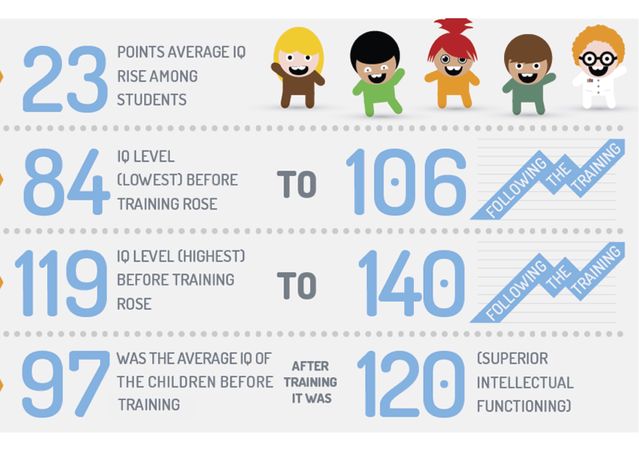
A new scientific paper I produced along with Sarah Cassidy and other
colleagues, published in the journal Learning and Individual
Differences, shows that significant increases in general intelligence,
of 28 points on average, can be produced by undertaking online
relational skills training. Furthermore, significant improvements in
overall educational aptitude can be achieved by a few months of
practicing one's relational skills.
Bryan Roche
Source: Bryan Roche


In previous blogs, I have outlined the rationale behind this training
and argued that a Relational Frame Theory (RFT) approach to
intellectual development may hold the key to a functional approach to
brain training. That is, RFT claims to have identified some basic
building blocks of intellectual development, which center around the
ability to understand complex inter-relations among stimuli. For
example, understanding that if something is opposite to two other
things, then those two things must be the same as each other, involves a
relation skill. As another example, if one object is worth more than
another, the second one is worth less than the first. The idea that
these skills not only underlie intelligence, but constitute it, is core
to RFT, a modern behavioral approach, although it sits well with more
mainstream cognitive approaches.


While most of us are relatively proficient in basic relational
skills, we are actually quite deficient in solving more complex
relational problems. To address this deficiency, a form of online brain
training called SMART training (Strengthening mental abilities with
relational training) was developed by Relational Frame Theory
researchers at Maynooth University.


The Cassidy et al. study is the second such study to be published by
the Maynooth University team to show that SMART training can increase
general intelligence as measured by standardized IQ tests, such as the
Wechsler Intelligence Scale for Children (WISC). This new study,
however, provides additional evidence that scholastic ability, as
measured by a gold standard aptitude test known as the Differential
Aptitude Test (DATs), also increases as a result of this very particular
form of intellectual skills training.


As documented in previous research, the IQ rises cannot be easily
accounted for by practice at the IQ test, because the IQ test was
administered only twice, with a several month interval between
administrations. Furthermore, IQ rises due to practice are usually very
small compared to the rises reported in this latest study. Further
still, the training administered to the sample of 11-12 year old
children employed in Experiment 1 of this study, was dissimilar to an IQ
test. The same applies to the DATs aptitude test. This was administered
only twice, and the increases in scores observed for numerical and
verbal reasoning far outstripped the increases expected by practice at
the test itself. Once again, the online relational skills training did
not in any way teach the items on the DATs test.
Advertisement


This is the second SMART study to achieve what critics of “brain
training” treat as the benchmark for acceptable brain training; the
transfer of skills from the training to other tasks. In this regard the
Cassidy study provides more evidence that brain training can work to
enhance essential intellectual skills, at least if it focuses on
relational skills, or what RFT researchers call Arbitrarily Applicable
Relational Responding.


A common criticism of brain training is that while it may improve
some cognitive skills needed to complete the training, any benefits may
have no practical relevance to daily life. In the current study,
however, a sample of 30 14-15 year old children were tracked across
several months of online training, 2-3 times per week for 30-45 minutes.
Practice at relational skills, increased their numerical and verbal
reasoning abilities, as measured by the DATs (administered and scored by
independent third parties) by a significant degree. Together these
numerical indices are used by educators to assess a child’s overall
“educational aptitude”, which is the child’s ability to perform well in
school across the board. By finding a significant increase in scholastic
ability, the current study suggests that SMART relational skills
training can make a real and measurable difference to the educability of
a child.


While more evidence is always required when such promising results are reported by any new Brain Training
method, the case is mounting that a relational frame theory approach to
intellectual development may indeed have identified some basic building
blocks of intelligence, once thought to be an unchangeable trait.


Wednesday, 25 May 2016

New Evidence That IQ Can Be Increased With Brain Training | Psychology Today

New Evidence That IQ Can Be Increased With Brain Training | Psychology Today


A new scientific paper I produced along with Sarah Cassidy and other colleagues, published in the journal Learning and Individual Differences, shows that significant increases in general intelligence,
of 28 points on average, can be produced by undertaking online
relational skills training. Furthermore, significant improvements in
overall educational aptitude can be achieved by a few months of
practicing one's relational skills.


Bryan Roche
Source: Bryan Roche
In previous blogs, I have outlined the rationale behind this training and argued that a Relational Frame Theory (RFT) approach to intellectual development may hold the key to a functional approach to brain
training. That is, RFT claims to have identified some basic building
blocks of intellectual development, which center around the ability to
understand complex inter-relations among stimuli. For example, understanding
that if something is opposite to two other things, then those two
things must be the same as each other, involves a relation skill. As
another example, if one object is worth more than another, the second
one is worth less than the first. The idea that these skills not only
underlie intelligence, but constitute it, is core to RFT, a modern
behavioral approach, although it sits well with more mainstream cognitive approaches.


While most of us are relatively proficient in basic relational
skills, we are actually quite deficient in solving more complex
relational problems. To address this deficiency, a form of online brain
training called SMART training (Strengthening mental abilities with
relational training) was developed by Relational Frame Theory
researchers at Maynooth University.  


The Cassidy et al. study is the second such study to be published by the Maynooth University team
to show that SMART training can increase general intelligence as
measured by standardized IQ tests, such as the Wechsler Intelligence
Scale for Children (WISC). This new study, however, provides additional
evidence that scholastic ability, as measured by a gold standard
aptitude test known as the Differential Aptitude Test (DATs), also
increases as a result of this very particular form of intellectual
skills training.


As documented in previous research,
the IQ rises cannot be easily accounted for by practice at the IQ test,
because the IQ test was administered only twice, with a several month
interval between administrations. Furthermore, IQ rises due to practice
are usually very small compared to the rises reported in this latest
study. Further still, the training administered to the sample of 11-12
year old children employed in Experiment 1 of this study, was dissimilar
to an IQ test. The same applies to the DATs aptitude test. This was
administered only twice, and the increases in scores observed for
numerical and verbal reasoning far outstripped the increases expected by
practice at the test itself. Once again, the online relational skills
training did not in any way teach the items on the DATs test.

This is the second SMART study to achieve what critics of “brain
training” treat as the benchmark for acceptable brain training; the
transfer of skills from the training to other tasks. In this regard the
Cassidy study provides more evidence that brain training can work to
enhance essential intellectual skills, at least if it focuses on
relational skills, or what RFT researchers call Arbitrarily Applicable Relational Responding.


A common criticism of brain training is that while it may improve some cognitive
skills needed to complete the training, any benefits may have no
practical relevance to daily life. In the current study, however, a
sample of 30 14-15 year old children were tracked across several months
of online training, 2-3 times per week for 30-45 minutes. Practice at
relational skills, increased their numerical and verbal reasoning
abilities, as measured by the DATs (administered and scored by
independent third parties) by a significant degree. Together these
numerical indices are used by educators to assess a child’s overall
“educational aptitude”, which is the child’s ability to perform well in
school across the board. By finding a significant increase in scholastic
ability, the current study suggests that SMART relational skills
training can make a real and measurable difference to the educability of
a child.


While more evidence is always required when such promising results
are reported by any new brain training method, the case is mounting that
a relational frame theory approach to intellectual development may
indeed have identified some basic building blocks of intelligence, once
thought to be an unchangeable trait.  

Tuesday, 13 January 2015

RaiseYourIQ - The Future of Education

My Page - The Future of Education


Brian Connell's Page on The Future of Education


Brian Connell posted a blog post

Brain Training Online for Kids

Brain
training online for kids and students is fast becoming the recognised method as the best way to challenge their brains to work harder at subjects like math,science or reading while improving memory and IQ. In the internet of eveything, data and information overload can expose a
childs brain to more demands than even before. The education system does not address the need to teach students how to learn and acquire knowledge easier.Brain training online as a weekly routine will improve…See More
1 hour ago
Brian Connell posted a status
"Brain training helps with cognitive developement http://visual.ly/brain-training"
Wednesday
Brian Connell posted a status
"ADHD and ADD Brain Training http://raiseyouriq.com/faq/70"
Jan 6
Brian Connell posted a status
"Browse Brain training news, research and analysis http://theconversation.com/au/topics/brain-training"
Jan 6
Brian Connell posted a status
Jan 5
Brian Connell posted a status
Dec 19, 2014
Brian Connell posted a status
Dec 17, 2014
Brian Connell posted a status
Dec 16, 2014
Brian Connell joined Amy Brinkley's group
Thumbnail

RSCON 2014 Presenters

This
is the discussion and email group for conference presenters. You must
join this group as part of submitting a proposal, as important
communication with presenters will be sent to this group's members.See More
Dec 11, 2014
Brian Connell posted a status
Dec 11, 2014
Brian Connell posted a blog post

How to Increase Intelligence

Children
and adults can increase or improve intelligence and science supports
the fact that there are no factors imposed by biology or birth that
constrains intelligence gains over ones life. Psychologists at NUIM
University have shown with published research that IQ can be raised (see
Cassidy, Roche & Hayes, 2011) and that the IQ increases have a
permanent effect (Roche, Cassidy &Stewart, 2013). Memory is also an
essential part of the brains intellectual functioning and that this too…See More
Dec 5, 2014
Brian Connell posted a status
"Learning help with homework and school http://raiseyouriq.com/faq/60"
Dec 4, 2014
Brian Connell posted a status
"Tutoring and Homework Help using Brain Training https://raiseyouriq.com/faq/57"
Dec 1, 2014
Brian Connell posted a status
"Kids Learning Games http://raiseyouriq.com/faq/56"
Nov 26, 2014
Brian Connell posted a status
Nov 24, 2014
Brian Connell posted a blog post

Game Based Learning in Schools

The
use of “Game Based Learning” in schools and the classroom by teachers
can have a measurable effect on teaching methods and student success in
subjects like math, science, reading and languages. In the modern
education system game based learning and brain training solutions have
the potential to bolster teaching methods while educational games in the
classroom are fast proving an invaluable tool to connect and engage
students. Games in the classroom in any form have shown to increase
student…See More


Friday, 5 December 2014

Increase Intelligence

Anyone can increase intelligence as the brains memory is an essential part of the brains intellectual functioning and that this can be improved (see Jaeggi et al., 2008). These studies and others into intelligence show that IQ scores can be improved and that an IQ test is merely a good starting point for kids or adults to commence a journey towards increasing intellectual skills for meaningful gains in all walks of life. So what does it take to increase intelligence and raise IQ? Well advice from Doctor Sarah Cassidy, an educational psychologist and a co-founder at RaiseYourIQ includes


Psychologists have discovered that there is a strong correlation between a person’s relational skills and IQ scores (O’Hora, Pelaez & Barnes-Holmes; 2005, O’Toole & Barnes-Holmes;2009, Cassidy, Roche & Hayes; 2011, Roche, Cassidy & Stewart; 2013). Crucially we now know that relational skills can be taught to any person.


So improving your relational skills will in turn increase your IQ score. So what are Relational skills?, they are the understanding of a handful of mathematical relationships between concepts or objects such as things are the same as other things, more or less than other things, opposite to other things, and so on.


They also include relationships like before and after or that one thing is contained by another. Moreover, having a strong handle on the relationships between and among other things has been shown to enhance thinking and problem solving skills. In fact, these relational skills are now being called the building blocks of intelligence by psychologists in the field of Relational Frame Theory.

Read the full article here Increase Intelligence


Wednesday, 3 December 2014

Brain Training Gamification For Business

Gamification for business in the form of brain training can be used as a educational tool to train, test, assess, and develop  employees. Brain training as a gamification tool for business can work to increase the intellectual brain power of a team or group while improving collective problem solving skills.Brain training can be applied to testing employees IQ, problem solving ability, raise intellectual horsepower, sales training and in improving the overall learning capacity within a business.


When people talk about gamification, they think about games created for business training purposes. Gamification is about spotlighting the asset of an existing core  competency byusing the motivational techniques that make games so engaging. When you increase the intellectual capactiy of a work force companies can drive more sales, build stronger bonds even have higher customer satisfaction levels.


Given the recent engagement numbers released from Gallup, showing 71 percent of workers
are “not engaged” or “actively disengaged” in their work, brain training as a gamification tool is a fun, rewarding and beneficial way to reconnect employees. Brain training has both intellectual and health impact as healthy, fitter brains have been scientifically proven to be happier and more open to learning new ways to accomplish tasks. Brain training is a super learning and brain development tool for any business person or team.


Gamification in Business

Thursday, 2 October 2014

Is it really possible to increase intelligence?

We were once told that intelligence or IQ was fixed for life. However,years of research by doctors and psychologists has lead to thediscovery of the importance of relational skills to intelligence and it
took several more years to by scientists to figure out how best to teach these skills. Today we know that IQ can in fact be increased by quite a degree. There have also been considerable advances in neuroscience in recent years, that have led psychologists to conclude that the brain itself can be made “fitter” with training and can respond and adapt to improved learning opportunities. Even leading authorities, such as Professor Robert Sternberg, now agree that IQ can be raised.

People who have completed the SMART brain training course have seen an average 20-50 point increase or improvement in intelligence or IQ (in both formal IQ tests and IQ assessments). The whole principal andscience behind RaiseYourIQ is teaching people how to learn easier. So mathematics, reasoning,problem solving memory recall and verbal comprehension become easier to understand hence working the brain fitter. The proof of this process lies in taking a pre and post IQ
assessment test which is free at RaiseYourIQ. Many of our users take SMART brain training to help in education, exams, work tests and IQ tests like MENSA. increase intelligence

Monday, 29 September 2014

Brain Fitness

The way to improve brain fitness is to schedule in a few times a week to complete the stages on the SMART brain training course. It is a scientific fact that the fitter the brain, the easier learning becomes to us all. Brain training is all abouthaving a fitter brain, it does take time and effort and over the course of the 12-16 weeks on average it takes to complete the SMART course users will see a marked improvement to how psychologists measure brain fitness namely, thinking ability, ability of the brain to focus better and improved memory skills. Think of brain fitness like a gym membership, you make best use of it when you make the time to exercise. Brain Fitness

Monday, 8 September 2014

Brain Training Free

RaiseYourIQ offers anyone two ways to get some brain training free lessons. The first way is to sign-up for a free trial account. The first 15 lessons on the SMART brain training course are free which includes an IQ assessment test, apart from your email address no other information or credit card is required. Most of our students find this the easiest way to experience how brain training will help raise IQ levels and improve intelligence.

The second way is to download our "brain training free lessons" from our blog. This brain training is a series of questions in a PDF document that you can print off and practise at your leisure. No registration or information is required, just download and start working that brain fit. Click here Brain Training Free


These free brain training exercises will improve your brain performance in an enjoyable way no matter what age you are and they are a great introduction to improving IQ and intelligence. 


Friday, 5 September 2014

Brain training for Children

Teachers, Guardians and Parents should consider using brain training for children and students to help improve their IQ levels and so assist them in their educational pursuits. The idea that a childs or persons Intelligence Quotient (IQ) is fixed for life is a myth and for far to long as been used as an excuse for poor teaching and learning methods.


 Brain training for Children

If a childs brain needs a power up, then the RaiseYourIQ intellectual skills intervention called "SMART brain training" (Strengthening Mental Abilities with Relational Training). We do not teach children and students anything that they can use in their examinations (e.g., how to multiply, the capital of Canada). Instead a RaiseYourIQ course will teach the foundational reasoning skills crucial to vocabulary acquisition and mathematical reasoning. In effect, we are giving kids, students and adults the tools to learn more effectively. Moreover our training re-mediates deficits in these skills bases that cannot be taught at school efficiently without extensive one-to-one assistance, plus SMART can even help children to catch up to and even surpass the population average in intellectual ability. The SMART brain training course can act as a springboard from which future learning occurs across all age groups.


Thursday, 28 August 2014

Identifying the Basic Building Blocks of Intelligence | Psychology Today

This Psychology Today article on the Building Blocks of Intelligence was written by Doctor Bryan Roche in his IQ Boot Camp expert blog, Bryan is a co-founder of RaiseYourIQ.com. In this article he poses the question "Will honing your relational framing skills make you smarter?"

The full article can be read on Psychology Today at the below link


Identifying the Basic Building Blocks of Intelligence | Psychology Today

Wednesday, 27 August 2014

Children Need Brain Training

As a psychologist and educator I put forward the arguement that children need brain training as
part of their education in schools. Why?. In my experience schools are not equipped to help children reach their intellectual potential. As much as we may like to believe it, schools are not perfect places in which to educate a child. While they may do their utmost within budgetary constraints to impart the knowledge and skills a child needs to function in the world as an adult, they simply cannot provide the one-to-one attention that a child needs to reach their full intellectual potential. Even if a parent is fortunate enough to afford private schooling of the highest standard, or private tutoring from leading scholars, this still cannot maximize intellectual development for a surprisingly simple reason: those experts don’t know what to teach to make that happen.

brian-training


While an expensive tutoring company will boast about improvements in school grades, they achieve this only by “teaching to the examination”, whatever that may be; SATs, a University entrance exam, or whatever. In other words, intensive education usually focuses on knowledge content and some  basic skills tested directly in examinations. None of this will enhance a child’s overall intellectual ability much. That approach simply does not provide practice at skills basic enough that learning itself becomes easier. And the reason that most education leaves the child knowing more, but not any smarter, is because until now educational psychologists and neuroscientists did not fully understand
what skills precisely underlie “being smart”.


The Good News for Every Child
Psychology research in a field known as Relational Frame Theory has identified what are known as “relational skills” as the building block skills that underlie intelligence. The good news is that relational skills can be taught to any child through a form of “brain training”, and dozens of published research studies have now shown this, and argue that this is the kind of training every child needs to really maximize their potential in school and in life.


Relational skills brain training teaches a range of crucial relational skills that help to sharpen  intellectual ability. When these skills are improved, the research suggests, all intellectual tasks come
easier. Relational skills training make you a faster and better learner. It helps new information make more sense, and helps you think more clearly.


Because the school system does not directly teach relational skills, a child can quickly fall behind as they rote learn what is required to do well in school, but without the intellectual skill foundation to make that information meaningful and easy to remember. As a result, they can fall further and further behind over the years, as the effects of their poorly developed basic intellectual skills increase with the increasing demands of education. However, the identification of relational skills as the basic building blocks of intelligence, offers the possibility of re-mediating these deficits in a very efficient way so that educational efforts will be more effective and so that even disadvantaged children
can reach their educational potential.


What Does Relational Skills Training Involve and Where can I get it? Currently, relational skills brain training, which is a form of brain training, is only available online at www.raiseyouriq.com. It can be taken by children or adults, and simply requires completing a series of game-like tasks, for a few short sessions each week, for several weeks. The training involves teaching the user how to  answer blocks of logical questions, first with feedback, and then on their own without any help. The user is taught by the software how to solve these short logical problems, and is gently guided through increasingly difficult tasks that become increasingly easy for the user to solve.


The method employed at RaiseYourIQ.com was developed by behavioral  psychologists over a decade of laboratory research, and is called SMART (which stands for Strengthening Mental Abilities with Relational Training). SMART teaches the user how to learn and how to think more clearly and logically.


Published research shows that SMART training increases the IQ scores (i.e). the standard measure of our intelligence level) of users by at least 10, and up to around 30 points, which represents a highly
significant increase in intellectual ability. It also appears that a high starting intelligence level does not reduce the effects of the training, with intelligent children, becoming even more intelligent. This is because there is no limit to how relationally skilled a user can become. SMART Brain Training For Kids allows infinite improvement because users are encouraged to regularly revise stages of training that they have already mastered, and this helps them become more accurate and faster in solving problems. Even after completion they can continue to train at their own convenience. Our child users typically attain at least a typical adult level of logical reasoning and ability following their training.


SMART brain training targets the foundational intellectual skills that underlie just about everything we do, but specifically the following activities rely heavily on relational skills.


• Using vocabulary

• Understanding word meaning

• Grasping basic and advanced logic

• Remembering information

• Using numbers for mathematics


You can learn more about relational skill brain training here, Brain Training Free where everyone is welcome to sign up for a free trial course.

Scientifically Developed Intellectual Skills Training

Monday, 25 August 2014

Smart Brain Training Scientific Evidence

RaiseYourIQ have been involved both as scientists and psychologists in the development of the SMART brain training educational method within the behavioral research community in which the
idea of “relational skills” first evolved. The RaiseYourIQ approach to brain training is based on Relational Frame Theory – a modern theory of cognition, that our team of psychologists have helped to develop over the past two decades.


RaiseYourIQ is the only online brain training company offering online relational skills training
based on the tried and tested methods of applied behavior analysis (ABA). These technologies have developed over decades in a research tradition started by the now legendary psychologist B.F Skinner. Skinner was not a brain scientist. He was an expert in the science of learning and teaching. Skinner’s ideas eventually led to the development of supremely successful treatments for a whole range of educational and intellectual deficits including autism spectrum disorders, and his approach taught us how to help individuals reach and surpass their intellectual potential.


So successful is the applied behavior analysis approach that it is widely considered to be the most effective treatment for autism known to science and it is used by leading scientists and therapists all over the world, in private clinics and in the mainstream school system to help children at every level of academic ability. SMART BRAIN TRAINING has emerged from this applied behavior analysis tradition, and provides a training system that teaches the fundamental concepts required for intellectual development.


Some Published Scientific Research Papers Supporting the SMART Approach


Barnes-Holmes, Y., Barnes-Holmes, D., Roche, B. & Smeets, P. M.
(2001). Exemplar training and a derived transformation of function in
accordance with symmetry: II. The Psychological Record, 51, 589-603.


Barnes-Holmes, Y., Barnes-Holmes, D. & Cullinan, V. (2001). In
Relational frame theory: A post-Skinnerian account of human language and
cognition. Hayes, S. C. (Ed.); Barnes-Holmes, D. (Ed.); Roche, B.
(Ed.), (pp. 181-195). New York, NY, US: Kluwer Academic/Plenum


Barnes-Holmes, Y., Barnes-Holmes, D. & Murphy, C. (2004).
Teaching the generic skills of language and cognition: Contributions
from relational frame theory. In Moran, Daniel J. (Ed.); Malott,
Richard W. (Ed.), Evidence-based educational methods. San Diego, CA, US:
Elsevier Academic Press.


Barnes-Holmes, Y., Barnes-Holmes, D., Roche, B., Healy, O., Lyddy,
F., Cullinan, V. & Hayes, S. C. (2001). Psychological
Development. In Hayes, Steven C. (Ed.); Barnes-Holmes, Dermot (Ed.);
Roche, Bryan (Ed.), Relational frame theory: A post-Skinnerian account
of human language and cognition (pp. 157-180). New York, NY, US: Kluwer
Academic/Plenum Publishers, 2001.


Barnes-Holmes, Y., Barnes-Holmes, D., Roche, B. & Smeets, P. M.
(2001). Exemplar training and a derived transformation of function in
accordance with symmetry. The Psychological Record, 51, 287-308.


Berens, N. M. & Hayes, S. C. (2007). Arbitrarily applicable
comparative relations: Experimental evidence for a relational operant.
Journal of Applied Behavior Analysis, 40, 45-71.


Cassidy, S., Roche, B. & Hayes, S. C. (2011). A relational
frame training intervention to raise Intelligence Quotients: A pilot
study. The Psychological Record, 61, 173-198.


Cassidy, S., Roche, B. & O’Hora, D. (2010). Relational Frame
Theory and human intelligence. European Journal of Behavior Analysis,
11, 37-51.


Christoff, K., Keramatian, K., Gordon, A. M., Smith, R., &
Mädler, B. (2009). Prefrontal organization of cognitive control
according to levels of abstraction. Brain Research, 1286, 94-105.


Gómez, S. López, F., ; Martín, C. B., Barnes-Holmes, Y. &
Barnes-Holmes, D. (2007). Exemplar training and a derived
transformation of functions in accordance with symmetry and equivalence.
The Psychological Record, 57, 273-294.


Gore, N. J.; Barnes-Holmes, Yvonne & Murphy, Glynis. (2010). The
Relationship between Intellectual Functioning and Relational
Perspective-Taking. International Journal of Psychology &
Psychological Therapy, 10, 1-17.

Gorham, Marie; Barnes-Holmes, Y., Barnes-Holmes, D. & Berens, N.
(2009). Derived comparative and transitive relations in young children
with and without autism. The Psychological Record, 59, 221-246.


Christoff, K., Keramatian, K., Gordon, A. M., Smith, R., &
Mädler, B. (2009). Prefrontal organization of cognitive control
according to levels of abstraction. Brain Research, 1286, 94-105.


Luciano, C., Becerra, I. G., & Valverde, M. R. (2007). The role
of multiple-exemplar training and naming in establishing derived
equivalence in an infant. Journal of the Experimental Analysis of
Behavior, 87, 349-365.


McHugh, L., Barnes-Holmes, Y., & Barnes-Holmes, D. (2004).
Relational Frame Account of the Development of Complex Cognitive
Phenomena: Perspective-taking, False Belief Understanding, and
Deception. International Journal of Psychology & Psychological
Therapy, 4, 303-324.


McHugh, L., Barnes-Holmes, Y., & Barnes-Holmes, D.
Perspective-Taking as Relational Responding: A Developmental Profile.
(2004). The Psychological Record, 54, 115-144.


Murphy, C., Barnes-Holmes, D. & Barnes-Holmes, Y. (2005).
Derived manding in children with autism: Synthesizing Skinner's verbal
behavior with relational frame theory. Journal of Applied Behavior
Analysis, 38, 445-462.


Murphy, C., & Barnes-Holmes, D. (2009). Derived more-less
relational mands in children diagnosed with autism. Journal of Applied
Behavior Analysis, 42, 253-268.


Murphy, C., & Barnes-Holmes, D. (2009). Establishing derived
manding for specific amounts with three children: An attempt at
synthesizing Skinner's Verbal Behavior with relational frame theory. The
Psychological Record, 59, 75-92.


Oberauer, K. (2003). The multiple faces of working memory: Storage,
processing, supervision, and coordination. Intelligence, 31(2), 167-193.


O'Connor, J., Barnes-Holmes, Y., & Barnes-Holmes, D. (2011).
Establishing contextual control over symmetry and asymmetry performances
in typically developing children and children with autism. The
Psychological Record, 61, 287-312.


O'Toole, C., Barnes-Holmes, D., Murphy, C., O'Connor, J., &
Barnes-Holmes, Y. (2009). Relational flexibility and human
intelligence: Extending the remit of Skinner's Verbal Behavior.
International Journal of Psychology & Psychological Therapy, 9,
1-17.


Ramsden, S., Richardson, F. M., Josse,G., Thomas, M. S. C., Ellis,
C., Shakeshaft, C., Seghier, M. L. & Price, C. P. (2011). Verbal
and non-verbal intelligence changes in the teenage brain. Nature 479,
113–116.


Rehfeldt, R. & Barnes-Holmes, Y. (2009). Derived Relational
Responding: Applications for Learners with Autism and other
Developmental Disabilities: A Progressive Guide to Change. Oakland, CA:
New Harbinger.


Roche, B., Cassidy, S. & Stewart, I. (2013). Nurturing genius:
Realizing a foundational aim of Psychology, In Kashdan, T &
Ciarrochi, J. (Eds.), Cultivating well-being: Treatment innovations in
Positive Psychology, Acceptance and Commitment Therapy, and beyond, pp.
267-302. Oakland, CA: New Harbinger.


Rosales, R., Rehfeldt, R., & Lovett, S. (2011). Effects of
multiple exemplar training on the emergence of derived relations in
preschool children learning a second language. Analysis of Verbal
Behavior, 27, 61-74.


Stewart, I., Tarbox, J., Roche, B., & O’Hora, D. (2013).
Education, intellectual development, and relational frame theory. In
Dymond, S. & Roche, B. (Eds.), Advances in Relational Frame Theory:
Research & Application, pp. 178-198. Oakland, CA: New Harbinger.


Vitale, A., Barnes-Holmes, Y., Barnes-Holmes, D., & Campbell, C.
(2008). Facilitating responding in accordance with the relational frame
of comparison: Systematic empirical analyses. The Psychological
Record, 58, 365-390.


Weil, T. M., Hayes, S. C., & Capurro, P. (2011). Establishing a
deictic relational repertoire in young children. The Psychological
Record, 61, 371-390.

Brain Training Scientific Evidence

Thursday, 21 August 2014

Can I Increase My Intelligence?

People and students often ask the question "Can I increase my intelligence" by using some tools or games. Fist things first, What is Intellgence and IQ?

Well intelligence is defined at the ability to learn, understand and makejudgments or have opinions that are based on reason. Being intelligent means having the ability to acquire and use knowledge for solving problems and adapting to the world. IQ is simply the unit of measure for expressing the results of intelligence tests. Specifically, IQ is the ratio of a subject’s mental age (as determined by their performance on an intelligence scale) and chronological age.


There are many types of intelligence, but only standard IQ predicts your success at school and in work. In fact studies show people with higher IQ scores complete more years in school and have higher status jobs. Recent research has also found that people with higher IQs are also happier and healthier. While you do not need to have a high IQ for its own sake, improving your intellectual
ability will help you deal more effectively with school and work challenges, as well as make decisions and solve everyday problems more easily.


So the answer to the question is Yes. However there is no easy fix, just like training in your body in a gym, exercising the brain to become fitter involves time and study. RaiseYourIQ believes that brain training is about teaching people to learn. So brain training is a learning method to enhance a persons 
ability to learn faster, easier, and better. The science to brain training is that the brain processes information through a network of nerve cells called neurons and as a brain learns, groupings of neurons physically work together to accomplish learning or thinking tasks. So brain training is a skills course that requires a few hours a week over 8 to 12 weeks where a final IQ test will indicate the level of improvement. Learn more about SMART brain training here.