Showing posts with label education. Show all posts

Thursday, 16 June 2016

New Evidence That IQ Can Be Increased With Brain Training

New Evidence That IQ Can Be Increased With Brain Training


A new scientific paper I produced along with Sarah Cassidy and other
colleagues, published in the journal Learning and Individual
Differences, shows that significant increases in general intelligence,
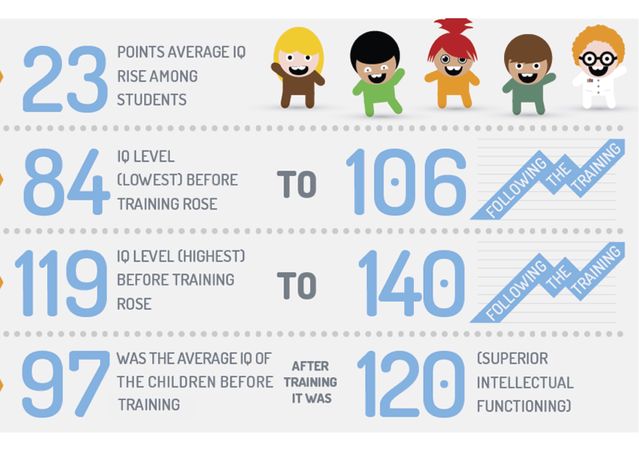
of 28 points on average, can be produced by undertaking online
relational skills training. Furthermore, significant improvements in
overall educational aptitude can be achieved by a few months of
practicing one's relational skills.
Bryan Roche
Source: Bryan Roche


In previous blogs, I have outlined the rationale behind this training
and argued that a Relational Frame Theory (RFT) approach to
intellectual development may hold the key to a functional approach to
brain training. That is, RFT claims to have identified some basic
building blocks of intellectual development, which center around the
ability to understand complex inter-relations among stimuli. For
example, understanding that if something is opposite to two other
things, then those two things must be the same as each other, involves a
relation skill. As another example, if one object is worth more than
another, the second one is worth less than the first. The idea that
these skills not only underlie intelligence, but constitute it, is core
to RFT, a modern behavioral approach, although it sits well with more
mainstream cognitive approaches.


While most of us are relatively proficient in basic relational
skills, we are actually quite deficient in solving more complex
relational problems. To address this deficiency, a form of online brain
training called SMART training (Strengthening mental abilities with
relational training) was developed by Relational Frame Theory
researchers at Maynooth University.


The Cassidy et al. study is the second such study to be published by
the Maynooth University team to show that SMART training can increase
general intelligence as measured by standardized IQ tests, such as the
Wechsler Intelligence Scale for Children (WISC). This new study,
however, provides additional evidence that scholastic ability, as
measured by a gold standard aptitude test known as the Differential
Aptitude Test (DATs), also increases as a result of this very particular
form of intellectual skills training.


As documented in previous research, the IQ rises cannot be easily
accounted for by practice at the IQ test, because the IQ test was
administered only twice, with a several month interval between
administrations. Furthermore, IQ rises due to practice are usually very
small compared to the rises reported in this latest study. Further
still, the training administered to the sample of 11-12 year old
children employed in Experiment 1 of this study, was dissimilar to an IQ
test. The same applies to the DATs aptitude test. This was administered
only twice, and the increases in scores observed for numerical and
verbal reasoning far outstripped the increases expected by practice at
the test itself. Once again, the online relational skills training did
not in any way teach the items on the DATs test.
Advertisement


This is the second SMART study to achieve what critics of “brain
training” treat as the benchmark for acceptable brain training; the
transfer of skills from the training to other tasks. In this regard the
Cassidy study provides more evidence that brain training can work to
enhance essential intellectual skills, at least if it focuses on
relational skills, or what RFT researchers call Arbitrarily Applicable
Relational Responding.


A common criticism of brain training is that while it may improve
some cognitive skills needed to complete the training, any benefits may
have no practical relevance to daily life. In the current study,
however, a sample of 30 14-15 year old children were tracked across
several months of online training, 2-3 times per week for 30-45 minutes.
Practice at relational skills, increased their numerical and verbal
reasoning abilities, as measured by the DATs (administered and scored by
independent third parties) by a significant degree. Together these
numerical indices are used by educators to assess a child’s overall
“educational aptitude”, which is the child’s ability to perform well in
school across the board. By finding a significant increase in scholastic
ability, the current study suggests that SMART relational skills
training can make a real and measurable difference to the educability of
a child.


While more evidence is always required when such promising results are reported by any new Brain Training
method, the case is mounting that a relational frame theory approach to
intellectual development may indeed have identified some basic building
blocks of intelligence, once thought to be an unchangeable trait.


Wednesday, 25 May 2016

New Evidence That IQ Can Be Increased With Brain Training | Psychology Today

New Evidence That IQ Can Be Increased With Brain Training | Psychology Today


A new scientific paper I produced along with Sarah Cassidy and other colleagues, published in the journal Learning and Individual Differences, shows that significant increases in general intelligence,
of 28 points on average, can be produced by undertaking online
relational skills training. Furthermore, significant improvements in
overall educational aptitude can be achieved by a few months of
practicing one's relational skills.


Bryan Roche
Source: Bryan Roche
In previous blogs, I have outlined the rationale behind this training and argued that a Relational Frame Theory (RFT) approach to intellectual development may hold the key to a functional approach to brain
training. That is, RFT claims to have identified some basic building
blocks of intellectual development, which center around the ability to
understand complex inter-relations among stimuli. For example, understanding
that if something is opposite to two other things, then those two
things must be the same as each other, involves a relation skill. As
another example, if one object is worth more than another, the second
one is worth less than the first. The idea that these skills not only
underlie intelligence, but constitute it, is core to RFT, a modern
behavioral approach, although it sits well with more mainstream cognitive approaches.


While most of us are relatively proficient in basic relational
skills, we are actually quite deficient in solving more complex
relational problems. To address this deficiency, a form of online brain
training called SMART training (Strengthening mental abilities with
relational training) was developed by Relational Frame Theory
researchers at Maynooth University.  


The Cassidy et al. study is the second such study to be published by the Maynooth University team
to show that SMART training can increase general intelligence as
measured by standardized IQ tests, such as the Wechsler Intelligence
Scale for Children (WISC). This new study, however, provides additional
evidence that scholastic ability, as measured by a gold standard
aptitude test known as the Differential Aptitude Test (DATs), also
increases as a result of this very particular form of intellectual
skills training.


As documented in previous research,
the IQ rises cannot be easily accounted for by practice at the IQ test,
because the IQ test was administered only twice, with a several month
interval between administrations. Furthermore, IQ rises due to practice
are usually very small compared to the rises reported in this latest
study. Further still, the training administered to the sample of 11-12
year old children employed in Experiment 1 of this study, was dissimilar
to an IQ test. The same applies to the DATs aptitude test. This was
administered only twice, and the increases in scores observed for
numerical and verbal reasoning far outstripped the increases expected by
practice at the test itself. Once again, the online relational skills
training did not in any way teach the items on the DATs test.

This is the second SMART study to achieve what critics of “brain
training” treat as the benchmark for acceptable brain training; the
transfer of skills from the training to other tasks. In this regard the
Cassidy study provides more evidence that brain training can work to
enhance essential intellectual skills, at least if it focuses on
relational skills, or what RFT researchers call Arbitrarily Applicable Relational Responding.


A common criticism of brain training is that while it may improve some cognitive
skills needed to complete the training, any benefits may have no
practical relevance to daily life. In the current study, however, a
sample of 30 14-15 year old children were tracked across several months
of online training, 2-3 times per week for 30-45 minutes. Practice at
relational skills, increased their numerical and verbal reasoning
abilities, as measured by the DATs (administered and scored by
independent third parties) by a significant degree. Together these
numerical indices are used by educators to assess a child’s overall
“educational aptitude”, which is the child’s ability to perform well in
school across the board. By finding a significant increase in scholastic
ability, the current study suggests that SMART relational skills
training can make a real and measurable difference to the educability of
a child.


While more evidence is always required when such promising results
are reported by any new brain training method, the case is mounting that
a relational frame theory approach to intellectual development may
indeed have identified some basic building blocks of intelligence, once
thought to be an unchangeable trait.  

Tuesday, 13 January 2015

RaiseYourIQ - The Future of Education

My Page - The Future of Education


Brian Connell's Page on The Future of Education


Brian Connell posted a blog post

Brain Training Online for Kids

Brain
training online for kids and students is fast becoming the recognised method as the best way to challenge their brains to work harder at subjects like math,science or reading while improving memory and IQ. In the internet of eveything, data and information overload can expose a
childs brain to more demands than even before. The education system does not address the need to teach students how to learn and acquire knowledge easier.Brain training online as a weekly routine will improve…See More
1 hour ago
Brian Connell posted a status
"Brain training helps with cognitive developement http://visual.ly/brain-training"
Wednesday
Brian Connell posted a status
"ADHD and ADD Brain Training http://raiseyouriq.com/faq/70"
Jan 6
Brian Connell posted a status
"Browse Brain training news, research and analysis http://theconversation.com/au/topics/brain-training"
Jan 6
Brian Connell posted a status
Jan 5
Brian Connell posted a status
Dec 19, 2014
Brian Connell posted a status
Dec 17, 2014
Brian Connell posted a status
Dec 16, 2014
Brian Connell joined Amy Brinkley's group
Thumbnail

RSCON 2014 Presenters

This
is the discussion and email group for conference presenters. You must
join this group as part of submitting a proposal, as important
communication with presenters will be sent to this group's members.See More
Dec 11, 2014
Brian Connell posted a status
Dec 11, 2014
Brian Connell posted a blog post

How to Increase Intelligence

Children
and adults can increase or improve intelligence and science supports
the fact that there are no factors imposed by biology or birth that
constrains intelligence gains over ones life. Psychologists at NUIM
University have shown with published research that IQ can be raised (see
Cassidy, Roche & Hayes, 2011) and that the IQ increases have a
permanent effect (Roche, Cassidy &Stewart, 2013). Memory is also an
essential part of the brains intellectual functioning and that this too…See More
Dec 5, 2014
Brian Connell posted a status
"Learning help with homework and school http://raiseyouriq.com/faq/60"
Dec 4, 2014
Brian Connell posted a status
"Tutoring and Homework Help using Brain Training https://raiseyouriq.com/faq/57"
Dec 1, 2014
Brian Connell posted a status
"Kids Learning Games http://raiseyouriq.com/faq/56"
Nov 26, 2014
Brian Connell posted a status
Nov 24, 2014
Brian Connell posted a blog post

Game Based Learning in Schools

The
use of “Game Based Learning” in schools and the classroom by teachers
can have a measurable effect on teaching methods and student success in
subjects like math, science, reading and languages. In the modern
education system game based learning and brain training solutions have
the potential to bolster teaching methods while educational games in the
classroom are fast proving an invaluable tool to connect and engage
students. Games in the classroom in any form have shown to increase
student…See More


Monday, 1 December 2014

Tutoring and Homework Help using Brain Training

Why do students have to wade through session after session of  reading and learning to
complete homework assignments, when some brain training exercises can speed up the acquisition of knowledge. 


The SMART brain training program can be used as a tutoring and homework aid as it works across school curriculum to make learning mathematics, languages,reading and science easier. SMART brain training acts like an online tutor, showing kids how to learn faster and easier no matter what
the topic. SMART brain training has been developed by educational psychologists following over 10 years of research and is now scientifically proven to raise IQ by 20-30 regardless of the child's
intellectual development. For more information on the RaiseYourIQ team, and the science behind SMART brain training please read our web section of "What is SMART"

 
Tutoring and Homework Help using Brain Training

Monday, 24 November 2014

Learning Games

Learning games are designed to help kids make learning easier for math,science and languages. Now teachers and schools are starting to use brain training as a fun yet educational learning game to improve students IQ.


To support the impact brain training can have as a learning tool and how it can increase intelligence, a published research paper (Cassidy,Roche & Hayes, 2011) described how a range of different children
(four normally developing and eight educationally challenged) were provided with SMART brain training as a learning game on a computer in once to twice weekly sessions lasting approximately 90 minutes across several months. IQ tests (WISC III) were administered before the relational training and several weeks following the completion of training.

The results showed the average IQ was raised to over 130,which is called high functioning or exceptional. This means that these children’s intellectual ability was moved from average range to within the top 2% of the population simply by using brain training as a learning game. Any parent,teacher or psychologist is welcome to contact RaiseYourUQ for a full copy of this report.

RaiseYourIQ a psychologists run company, continues to publish research into brain training within the school and education system.

Friday, 5 September 2014

Brain training for Children

Teachers, Guardians and Parents should consider using brain training for children and students to help improve their IQ levels and so assist them in their educational pursuits. The idea that a childs or persons Intelligence Quotient (IQ) is fixed for life is a myth and for far to long as been used as an excuse for poor teaching and learning methods.


 Brain training for Children

If a childs brain needs a power up, then the RaiseYourIQ intellectual skills intervention called "SMART brain training" (Strengthening Mental Abilities with Relational Training). We do not teach children and students anything that they can use in their examinations (e.g., how to multiply, the capital of Canada). Instead a RaiseYourIQ course will teach the foundational reasoning skills crucial to vocabulary acquisition and mathematical reasoning. In effect, we are giving kids, students and adults the tools to learn more effectively. Moreover our training re-mediates deficits in these skills bases that cannot be taught at school efficiently without extensive one-to-one assistance, plus SMART can even help children to catch up to and even surpass the population average in intellectual ability. The SMART brain training course can act as a springboard from which future learning occurs across all age groups.


Thursday, 28 August 2014

Identifying the Basic Building Blocks of Intelligence | Psychology Today

This Psychology Today article on the Building Blocks of Intelligence was written by Doctor Bryan Roche in his IQ Boot Camp expert blog, Bryan is a co-founder of RaiseYourIQ.com. In this article he poses the question "Will honing your relational framing skills make you smarter?"

The full article can be read on Psychology Today at the below link


Identifying the Basic Building Blocks of Intelligence | Psychology Today

Wednesday, 27 August 2014

Children Need Brain Training

As a psychologist and educator I put forward the arguement that children need brain training as
part of their education in schools. Why?. In my experience schools are not equipped to help children reach their intellectual potential. As much as we may like to believe it, schools are not perfect places in which to educate a child. While they may do their utmost within budgetary constraints to impart the knowledge and skills a child needs to function in the world as an adult, they simply cannot provide the one-to-one attention that a child needs to reach their full intellectual potential. Even if a parent is fortunate enough to afford private schooling of the highest standard, or private tutoring from leading scholars, this still cannot maximize intellectual development for a surprisingly simple reason: those experts don’t know what to teach to make that happen.

brian-training


While an expensive tutoring company will boast about improvements in school grades, they achieve this only by “teaching to the examination”, whatever that may be; SATs, a University entrance exam, or whatever. In other words, intensive education usually focuses on knowledge content and some  basic skills tested directly in examinations. None of this will enhance a child’s overall intellectual ability much. That approach simply does not provide practice at skills basic enough that learning itself becomes easier. And the reason that most education leaves the child knowing more, but not any smarter, is because until now educational psychologists and neuroscientists did not fully understand
what skills precisely underlie “being smart”.


The Good News for Every Child
Psychology research in a field known as Relational Frame Theory has identified what are known as “relational skills” as the building block skills that underlie intelligence. The good news is that relational skills can be taught to any child through a form of “brain training”, and dozens of published research studies have now shown this, and argue that this is the kind of training every child needs to really maximize their potential in school and in life.


Relational skills brain training teaches a range of crucial relational skills that help to sharpen  intellectual ability. When these skills are improved, the research suggests, all intellectual tasks come
easier. Relational skills training make you a faster and better learner. It helps new information make more sense, and helps you think more clearly.


Because the school system does not directly teach relational skills, a child can quickly fall behind as they rote learn what is required to do well in school, but without the intellectual skill foundation to make that information meaningful and easy to remember. As a result, they can fall further and further behind over the years, as the effects of their poorly developed basic intellectual skills increase with the increasing demands of education. However, the identification of relational skills as the basic building blocks of intelligence, offers the possibility of re-mediating these deficits in a very efficient way so that educational efforts will be more effective and so that even disadvantaged children
can reach their educational potential.


What Does Relational Skills Training Involve and Where can I get it? Currently, relational skills brain training, which is a form of brain training, is only available online at www.raiseyouriq.com. It can be taken by children or adults, and simply requires completing a series of game-like tasks, for a few short sessions each week, for several weeks. The training involves teaching the user how to  answer blocks of logical questions, first with feedback, and then on their own without any help. The user is taught by the software how to solve these short logical problems, and is gently guided through increasingly difficult tasks that become increasingly easy for the user to solve.


The method employed at RaiseYourIQ.com was developed by behavioral  psychologists over a decade of laboratory research, and is called SMART (which stands for Strengthening Mental Abilities with Relational Training). SMART teaches the user how to learn and how to think more clearly and logically.


Published research shows that SMART training increases the IQ scores (i.e). the standard measure of our intelligence level) of users by at least 10, and up to around 30 points, which represents a highly
significant increase in intellectual ability. It also appears that a high starting intelligence level does not reduce the effects of the training, with intelligent children, becoming even more intelligent. This is because there is no limit to how relationally skilled a user can become. SMART Brain Training For Kids allows infinite improvement because users are encouraged to regularly revise stages of training that they have already mastered, and this helps them become more accurate and faster in solving problems. Even after completion they can continue to train at their own convenience. Our child users typically attain at least a typical adult level of logical reasoning and ability following their training.


SMART brain training targets the foundational intellectual skills that underlie just about everything we do, but specifically the following activities rely heavily on relational skills.


• Using vocabulary

• Understanding word meaning

• Grasping basic and advanced logic

• Remembering information

• Using numbers for mathematics


You can learn more about relational skill brain training here, Brain Training Free where everyone is welcome to sign up for a free trial course.

Scientifically Developed Intellectual Skills Training

Thursday, 21 August 2014

Can I Increase My Intelligence?

People and students often ask the question "Can I increase my intelligence" by using some tools or games. Fist things first, What is Intellgence and IQ?

Well intelligence is defined at the ability to learn, understand and makejudgments or have opinions that are based on reason. Being intelligent means having the ability to acquire and use knowledge for solving problems and adapting to the world. IQ is simply the unit of measure for expressing the results of intelligence tests. Specifically, IQ is the ratio of a subject’s mental age (as determined by their performance on an intelligence scale) and chronological age.


There are many types of intelligence, but only standard IQ predicts your success at school and in work. In fact studies show people with higher IQ scores complete more years in school and have higher status jobs. Recent research has also found that people with higher IQs are also happier and healthier. While you do not need to have a high IQ for its own sake, improving your intellectual
ability will help you deal more effectively with school and work challenges, as well as make decisions and solve everyday problems more easily.


So the answer to the question is Yes. However there is no easy fix, just like training in your body in a gym, exercising the brain to become fitter involves time and study. RaiseYourIQ believes that brain training is about teaching people to learn. So brain training is a learning method to enhance a persons 
ability to learn faster, easier, and better. The science to brain training is that the brain processes information through a network of nerve cells called neurons and as a brain learns, groupings of neurons physically work together to accomplish learning or thinking tasks. So brain training is a skills course that requires a few hours a week over 8 to 12 weeks where a final IQ test will indicate the level of improvement. Learn more about SMART brain training here.


Wednesday, 20 August 2014

Why Is SMART “Brain Training” different?

The SMART brain training course is not like any other form of brain training online or in clinics. Here at RaiseYourIQ we use the term "brain skills training", or a behavioral training course. The intellectual property behind SMART Brain Training has been developed by education leaders and published psychologists following over ten years research in schools and university.

smart-brain-training


The reason SMART Brain Training  is different is that it does not work by merely improving working memory or teaching users how to perform well on IQ tests.  Instead, our SMART brain training course teaches the fundamental cognitive skills necessary to improve learning and reasoning in
school,business and in everyday life.

SMART Brain Training enhances the entire intellectual skillset.

The web is full of brain training apps or games with no scientific support which just focus on working memory. The SMART Brain Training course (we want our users to see this as an educational course with real world benefits) covers the 4 key areas of "Intellectual Performance"

(1). Verbal Comprehension - improve ability to listen to a question and draw upon learned information

(2).Perceptual Reasoning - improve ability to examine a problem, organize thoughts, create solutions, and then test them

(3).Processing Speed - increase attention to quickly scan, discriminate between and order visual information

(4). Working Memory - increase the ability to memorize new information, hold it in short-term memory and concentrate

RaiseYourIQ offers a no obligation free trial (1st module is 100% free) together with a free IQ Assessment so people can judge for themselves. Brain Training Free The first module is 100% free and nocredit card is required.  To learn more about Why Is SMART “Brain Training” different?


Education is Linked To IQ

Scientific evidence nows shows that education is linked to higher IQ levels. If a person increases the intensity or duration of educational activity, it stimulates the brain to become fitter, making learning easier for any person whether its for school or business.


The view that a persons IQ is fixed for life and cannot be improved has been discredited thanks to several studies. One such study which was recently published by Norwegian scientists Christian N. Brinch and Taryn Ann Galloway. They got around the problem of trying to separate the effect of education on IQ from the possibility that more intelligent people simply choose to have more education. Their study involved examining the effects of an increase in the duration of compulsory
schooling in Norway in the 1960s. This change extended the minimum time in education for all Norwegians from 7 to 9 years. The authors cleverly hypothesized that the IQs of people who experienced this extra mandatory education should have increased by the time they reached
adulthood.


The researchers had access to excellent records of cognitive ability taken by the military for all eligible males at age 19 and they used these to calculate the IQ of each individual in the study. This allowed them to show that IQ had risen by 0.6 of a point on average for all Norwegian males over the period of study, but HAD RISEN BY 3.7 POINTS for every extra year of education received.

These findings provide very strong support for the ideas that education can increase IQ, but more importantly is that those people who are exposed to extra education benefit even greater. The conclusion is the more we learn, the fitter he brain becomes leading to improved levels of IQ. This poses the question, if children and adults know how to learn better, would our normal education system have a bigger impact on their intellectual development and life choices?


The rises in IQ from this study result from a very broad exposure to education extension, but research now shows that IQ rises obtained by an extra year of education are dwarfed by the IQ rises obtainable using the scientifically developed brain training developed by psychologists and authors at RaiseYourIQ, which helps the user to become expert in a range of cognitive skills underlying many forms of intelligence used in education, work, and in everyday life. Teaching people to learn easier and quicker using the brain training course leads to a 20-30 point IQ increase.


Click here to learn more about SMART Brain Training and the science behind it.

You can view the full original article conducted by the Norwegian
scientists here: [Brinch &
Galloway](http://www.pnas.org/content/109/2/

  
 Published originally by Doctor Bryan Roche, co-founder of RaiseYourIQ on his blog Educational Intervention To Raise Your IQ